
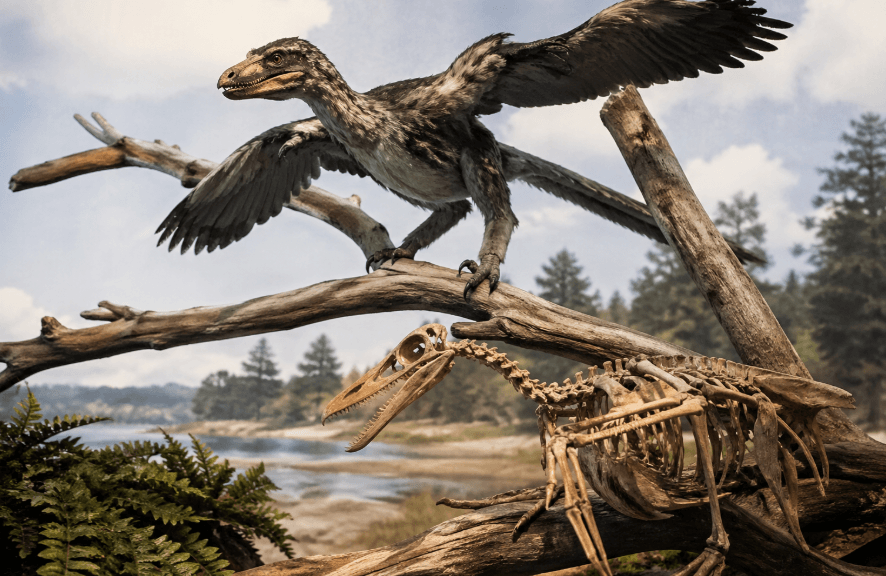
The idea that modern birds are the direct descendants of dinosaurs has fascinated scientists and the public alike for more than a century. While the theory is now widely accepted, many questions remain unanswered. Professor Steve Brusatte of the University of Edinburgh, author of The Story of Birds, sheds light on how this remarkable evolutionary journey unfolded—and why it still holds mysteries today.
Why the Dinosaur–Bird Connection Matters
For Professor Brusatte, the story begins with a lifelong fascination with birds and their extraordinary diversity—something familiar to anyone who has watched Britain’s varied birdlife, from urban pigeons to coastal seabirds.
His research has focused on theropods, the two-legged dinosaurs that include iconic species such as Tyrannosaurus rex and Velociraptor. These creatures are now understood to be the ancestors of modern birds.
Early in his academic career, Brusatte constructed evolutionary family trees to pinpoint where birds fit among dinosaurs. This work laid the foundation for a broader understanding of how feathers, wings and other defining features gradually emerged.
Are Birds Really Dinosaurs?
Although widely accepted in scientific circles, the idea that birds are living dinosaurs has not fully permeated public understanding.
The connection was first identified in the 19th century by Thomas Henry Huxley, a close associate of Charles Darwin. Huxley observed striking similarities between fossilised dinosaur skeletons and modern birds—well before DNA analysis existed.
While this theory gained traction in Victorian Britain, it later fell out of favour as large, imposing dinosaur fossils were discovered in North America. These reinforced the popular image of dinosaurs as massive, reptilian beasts, rather than agile, feathered animals.
Only in recent decades—particularly following fossil discoveries in China during the 1990s—has the presence of feathers on many dinosaurs firmly established the evolutionary link.
The Biggest Unanswered Questions
Despite progress, key mysteries remain.
How Did Dinosaurs Learn to Fly?
Scientists are still debating how flight first evolved. Some theories suggest small dinosaurs ran along the ground, using wings for lift. Others propose that they glided down from trees.
Fossil evidence shows a wide variety of feathered dinosaurs, many with different wing structures. This diversity makes it difficult to identify the exact evolutionary pathway that led to powered flight.
Why Did Feathers Evolve?
Feathers appeared long before flight. Early forms resembled simple filaments, likely used for insulation—similar to fur in mammals.
Later, feathers became more elaborate. Some dinosaurs developed wing-like structures that were too small to support flight. This suggests wings may initially have evolved for display—used to attract mates or deter rivals—before eventually enabling flight.
Size Matters: Why Birds Had to Shrink
A crucial factor in the evolution of birds was size reduction. While some dinosaurs grew ever larger, the lineage leading to birds became progressively smaller over millions of years.
Smaller bodies, combined with increasingly larger wings, eventually reached a tipping point where flight became physically possible. This aligns with the basic principles of aerodynamics: large animals struggle to achieve powered flight.
Even today, the largest flying birds, such as the wandering albatross, have a wingspan of around 3.5 metres. Fossil evidence suggests extinct species reached up to 7 metres—but beyond that, sustained flapping flight becomes impractical.
Survival After the Asteroid Impact
One of the most compelling questions is why birds survived the asteroid impact 66 million years ago, while other dinosaurs perished.
The answer lies in a combination of traits.
Many birds did go extinct, particularly those that still resembled their dinosaur ancestors. However, more modern birds—with beaks, strong flight القدرة and rapid growth cycles—were better equipped to survive.
Their small size allowed them to shelter from extreme conditions, while their ability to eat seeds proved crucial. In the aftermath of the asteroid, global ecosystems collapsed, and seeds were among the few reliable food sources.
The Rise of Modern Birds
Following the mass extinction, birds diversified rapidly. Genetic studies indicate a “burst” of evolution, leading to the emergence of many modern groups, including owls, parrots and birds of prey.
Fossils from this period remain scarce, but species such as Vegavis and Asteriornis provide early evidence of modern bird lineages.
Giants of the Bird World
Although today’s birds are relatively modest in size, the past tells a different story.
After the extinction of dinosaurs, birds occupied ecological roles once held by large reptiles. In South America, “terror birds” became apex predators. In Australia, enormous flightless birds—sometimes referred to as “demon ducks”—grew heavier than cattle.
Elsewhere, species such as the moa in New Zealand and the elephant bird in Madagascar reached extraordinary sizes, with eggs comparable to watermelons.
Are Birds Intelligent?
Birds have long been underestimated. The phrase “bird-brained” hardly reflects reality.
Relative to body size, bird brains are highly developed. Many species display complex behaviours, from learning songs—similar to language acquisition—to using and even crafting tools.
Crows, in particular, demonstrate problem-solving abilities comparable to some primates, challenging assumptions about animal intelligence.
When Did Birds Start Singing?
While sound does not fossilise, genetic and evolutionary studies suggest songbirds originated around 50 million years ago, likely in Australia.
Their diversification accelerated about 27 million years ago, influenced by shifting landmasses and changing environments in Southeast Asia. Today, songbirds make up more than half of all bird species.
The Search for the First True Birds
One of the most iconic fossils in evolutionary science is Archaeopteryx, discovered in the 19th century. It possessed both dinosaur and bird features, including teeth, claws and feathered wings.
However, scientists believe even earlier ancestors must have existed—species that could only glide or fly in a limited way. Discovering these fossils remains a key goal for palaeontologists.
Conclusion
The evolution of birds from dinosaurs is one of science’s most compelling stories, linking the prehistoric past to the natural world we see today. While major breakthroughs have clarified how feathers, wings and flight developed, significant gaps remain.
Each new fossil discovery adds both insight and complexity, ensuring that this evolutionary puzzle continues to challenge and inspire researchers for years to come.

Edward Langley is a contributor at Mediarunsearch.co.uk, covering a wide range of topics including news, politics, business, technology, sport, entertainment and lifestyle. He focuses on delivering clear, balanced reporting and useful information that helps readers stay informed about current affairs and developing stories. His work highlights issues, trends and events that matter to everyday audiences, with an emphasis on accuracy, relevance and accessible journalism.