
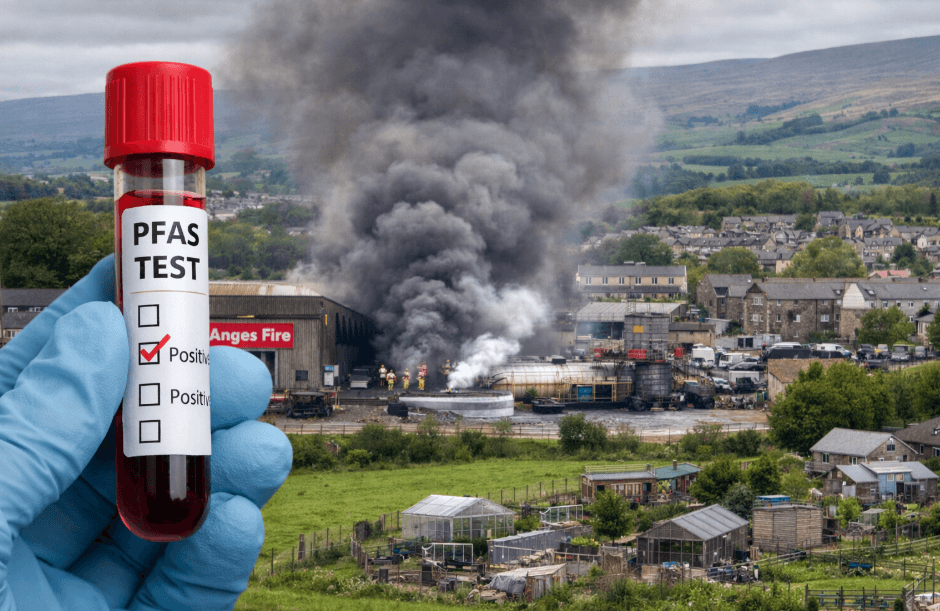
A rural community in North Yorkshire has been found to have unusually high levels of toxic “forever chemicals” in residents’ blood, raising fresh concerns about long-term environmental contamination and public health risks in the UK.
Blood Tests Reveal Widespread Exposure in Bentham
Residents of Bentham, a small market town on the edge of the Yorkshire Dales, have been found to carry elevated levels of per- and polyfluoroalkyl substances (PFAS) — a group of synthetic chemicals widely used in industrial processes and consumer goods.
Testing carried out for an upcoming ITV documentary revealed that nearly one in four participants had PFAS concentrations in the highest risk category, based on international benchmarks.
The findings follow a 2024 investigation which identified Bentham as the site of the highest recorded PFAS contamination in UK groundwater. The pollution was traced to land owned by Angus Fire, a manufacturer of firefighting foam containing PFAS, which operated at the site from 1976 until 2024.
What Are PFAS and Why Are They Dangerous?
PFAS are often referred to as “forever chemicals” due to their persistence in the environment and the human body. They have been linked to a range of serious health conditions, including certain cancers, immune system disruption and reproductive issues.
Despite growing international concern, the UK currently has no official guidance on safe PFAS levels in human blood. In contrast, the United States’ National Academies suggest that concentrations above 2 nanograms per millilitre (ng/ml) may pose health risks.
In Bentham, the highest recorded level reached 405 ng/ml — more than 200 times the US advisory threshold. This reading was found in a former worker at the local factory.
Significant Health Concerns Among Residents
Of the 39 individuals tested, 23% had PFAS levels exceeding 20 ng/ml — a threshold at which US experts recommend increased medical monitoring.
Among them is Stephen Illston, 34, whose PFAS level was measured at 55 ng/ml. He has experienced fertility problems and said the results may help explain years of uncertainty.
“It’s good to hear it’s not me,” he said. “Maybe it’s the PFAS that’s caused it.”
Scientific research increasingly links PFAS exposure to reduced fertility, including lower sperm counts, though causation in individual cases remains complex.
Experts ‘Shocked’ by Scale of Contamination
Dr David Megson, an environmental forensic scientist at Manchester Metropolitan University, described the findings as “exceptionally high” compared with typical background levels observed in the United States.
“Nearly everybody we tested was above average, and a significant proportion were among the highest levels we would expect to see anywhere,” he said.
Dr Shubhi Sharma, of the environmental charity Chem Trust, added that the results were “alarming”, particularly given the established links between PFAS exposure and serious health outcomes.
Evidence Points to Community-Wide Exposure
Experts believe the contamination is not limited to former factory workers. Elevated levels were also found in residents with no direct occupational exposure, suggesting wider environmental spread.
An internal Environment Agency report from 2024 identified airborne emissions from firefighting foam testing as a likely source. According to the report, chemicals released during testing could travel through the air before settling on soil and crops.
This raises the possibility of exposure through homegrown produce — a common feature of rural life in areas such as North Yorkshire, where allotments and kitchen gardens are widely used.
Dr Tony Fletcher, an epidemiologist at the London School of Hygiene and Tropical Medicine, said the data strongly indicated community exposure.
Residents Describe Regular Smoke Exposure
Local resident Lindsay Young, who recorded a PFAS level of 30 ng/ml, described frequent fire testing at the Angus Fire site.
“The siren would go off and you knew the smoke was coming within minutes,” she said. “Huge clouds of black smoke — and no one told us what was in it.”
Such accounts align with concerns raised in the Environment Agency’s assessment of “aerial dispersal” as a likely pathway for contamination.
Company and Regulatory Response
Angus Fire has disputed claims that the blood test results are unusually high in a UK context, stating that there is no internationally agreed framework for interpreting PFAS levels in blood.
The company said the sample size was small and emphasised that elevated PFAS levels do not directly equate to specific health outcomes.
It also noted that testing of PFAS-based foams at the Bentham site ceased in 2022 and argued that other sources may have contributed to environmental contamination in the area.
Meanwhile, regulatory responsibility appears fragmented. The Environment Agency confirmed that fire testing was not covered by the site’s permit, while North Yorkshire Council stated that such activities are exempt from restrictions under the Clean Air Act 1993 due to their connection with firefighting.
Treatment Options and Next Steps
In the absence of UK-specific guidelines, some experts are pointing to emerging international approaches. In Jersey, where PFAS contamination has also been identified, health advisers have recommended medical interventions — including cholesterol-lowering drugs — for individuals with elevated levels.
Specialists suggest that affected residents in Bentham may wish to consult their GP about monitoring and potential treatment options.
Conclusion
The findings from Bentham highlight a growing challenge for UK regulators as evidence mounts over the health risks posed by PFAS. With no clear national standards and increasing public concern, pressure is likely to build for more comprehensive monitoring, regulation and support for affected communities.

Edward Langley is a contributor at Mediarunsearch.co.uk, covering a wide range of topics including news, politics, business, technology, sport, entertainment and lifestyle. He focuses on delivering clear, balanced reporting and useful information that helps readers stay informed about current affairs and developing stories. His work highlights issues, trends and events that matter to everyday audiences, with an emphasis on accuracy, relevance and accessible journalism.