
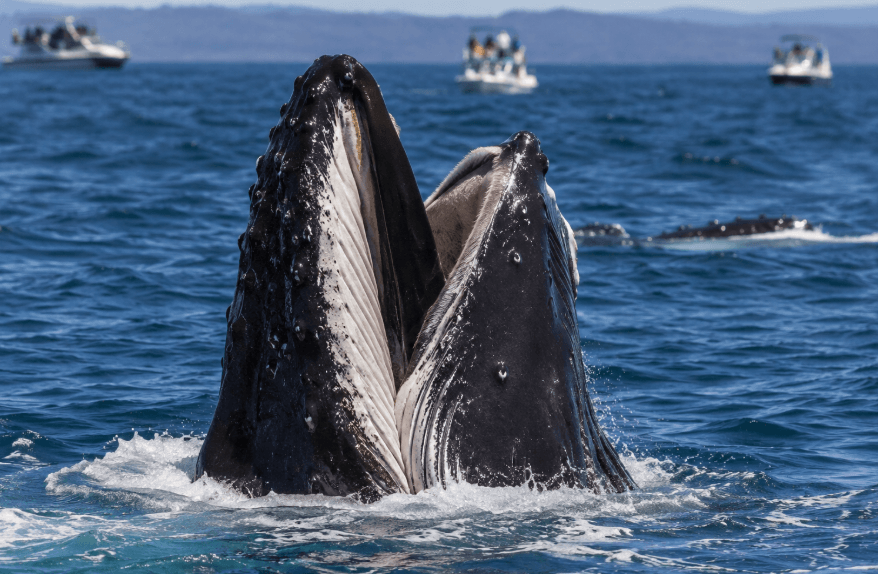
Researchers studying humpback whales have documented a rare and puzzling behaviour known as “gaping” as thousands of whales begin their annual migration along Australia’s coastline.
The unusual display, captured in footage shared online by whale-watchers and tourism operators, shows humpbacks opening their jaws wide while floating or moving slowly through the water — behaviour scientists believe may be linked to social interaction rather than feeding.
The findings come as humpback whales return to warmer waters off Queensland, northern New South Wales and Western Australia, marking the start of one of the world’s largest marine migrations and the beginning of whale-watching season.
Rare ‘Gaping’ Behaviour Intrigues Scientists
One of the clearest examples was filmed off the coast of Western Australia, where a humpback whale appeared to “pirouette” through the water with its jaw hanging open while surrounded by other whales.
Researchers from Macquarie University analysed social media footage and observations involving 66 humpback whales. Their study suggests the behaviour may serve as a form of social display, play, or communication.
Dr Vanessa Pirotta, co-author of the research paper and one of Australia’s best-known whale scientists, said citizen scientists and tourism operators had become increasingly valuable in documenting rarely seen marine behaviour.
“Just when we think we know a lot about humpback whales, we don’t,” Pirotta said.
She added that the unusual footage stood out immediately because of how rarely the behaviour is seen.
What Is Whale ‘Gaping’?
Baleen whales typically open their mouths widely during feeding, particularly when hunting krill or fish near the surface. Humpbacks often use coordinated feeding techniques, including bubble-net feeding, to trap prey before lunging upward with their mouths fully open.
However, scientists believe gaping is different.
Unlike feeding lunges, the whales displaying gaping behaviour are not accelerating rapidly or engulfing large volumes of water. Instead, the whales appear relatively calm, with their mouths held open either above or below the surface.
Researchers believe the behaviour could have several explanations, including:
Social Communication
Scientists suspect gaping may act as a visual signal between whales during migration or breeding periods.
Play or Curiosity
Humpbacks are widely regarded as highly inquisitive animals, often interacting with boats, floating debris and one another.
Jaw Stretching in Young Calves
Researchers also believe younger whales may use the movement to stretch or prepare their jaws before feeding seasons.
Whale Migration Season Begins Along Australia’s Coast
Each year, humpback whales travel thousands of miles from Antarctic feeding grounds to warmer breeding waters along Australia’s east and west coasts.
The migration usually runs from mid-May to mid-November, although sightings have already been reported this year along parts of New South Wales.
Katie Trepess, managing director of Whale Tales Whale Watching, said sightings on the east coast are especially significant because humpbacks generally fast during the migration period.
Rather than feeding, the whales rely largely on stored fat reserves while travelling and breeding.
Trepess said operators had also noticed increased “mugging” behaviour, where whales raise their heads above the surface to observe nearby boats — a movement commonly referred to as a “spyhop”.
Conservation Concerns as Whale Numbers Increase
While the migration attracts tourists and nature enthusiasts, conservation groups warn the journey remains increasingly dangerous for whales.
The Organisation for the Rescue and Research of Cetaceans in Australia, known as Orrca, reported a sharp rise in emergency calls earlier this year following multiple strandings and entanglements.
As whales travel closer to shore, they face growing threats from fishing equipment, pollution and vessel strikes.
Ashley Ryan, president of Orrca, described the migration as “one of nature’s great migrations” but warned it remains highly vulnerable.
Scientists say climate change, warming oceans and changing food supplies are also placing additional pressure on whale populations, increasing the importance of long-term monitoring programmes and citizen science efforts.
Best Places to Watch Whales in New South Wales
Authorities in New South Wales have highlighted several popular coastal viewpoints for spotting migrating humpbacks.
Among the best-known locations are:
Sydney Area
- Cape Solander in Kamay Botany Bay National Park
- Barrenjoey Lighthouse in Ku-ring-gai Chase National Park
- North Head and South Head in Sydney Harbour National Park
Regional NSW
- Cape Byron Lighthouse
- Yuraygir Coastal Walk near Coffs Harbour
- Tomaree Head Summit Walk in Port Stephens
- Jervis Bay and Seven Mile Beach
- Green Cape lookout in Eden
Officials are reminding the public to maintain safe viewing distances. Australian regulations require most vessels, drones and watercraft to remain at least 100 metres away from whales, extending to 300 metres when calves are present.
Citizen Scientists Play Growing Role
Researchers say footage captured by tourists, drone operators and local whale-watchers is becoming increasingly important in marine science.
With funding pressures affecting long-term monitoring projects, public observations are helping scientists track whale behaviour, migration patterns and emerging threats more effectively than ever before.
For many observers, the chance to witness a humpback breaching or displaying mysterious behaviour such as gaping remains one of the most memorable wildlife experiences Australia’s coastline can offer.

Edward Langley is a contributor at Mediarunsearch.co.uk, covering a wide range of topics including news, politics, business, technology, sport, entertainment and lifestyle. He focuses on delivering clear, balanced reporting and useful information that helps readers stay informed about current affairs and developing stories. His work highlights issues, trends and events that matter to everyday audiences, with an emphasis on accuracy, relevance and accessible journalism.