
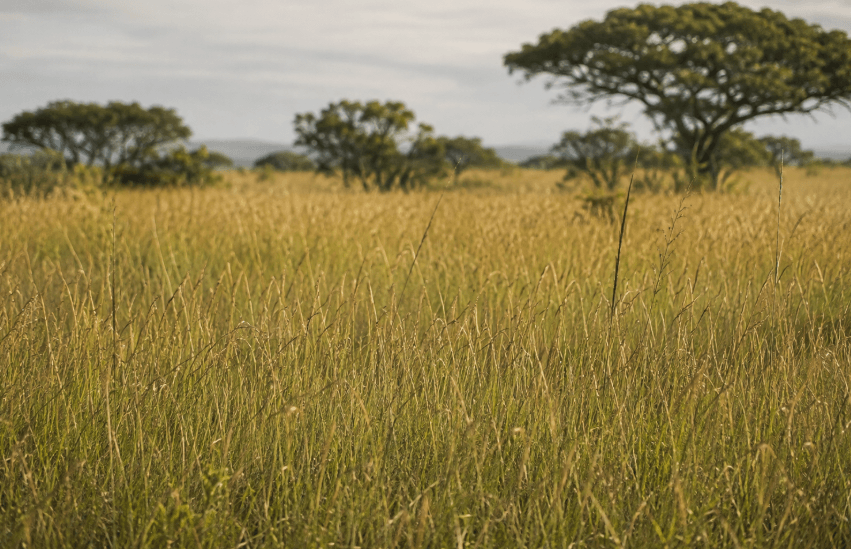
Rising levels of carbon dioxide in the atmosphere are driving stronger grass growth across some of Africa’s dry savannas, according to new research led by the University of Sheffield. Scientists say the trend could have significant implications for wildlife, wildfire activity and the global carbon cycle as atmospheric CO₂ concentrations continue to increase.
Higher CO₂ levels help savanna grasses conserve water
The research challenges a longstanding assumption about C₄ grasses, which dominate many tropical and subtropical savannas. These plants have generally been considered relatively unresponsive to increasing carbon dioxide because they already use an efficient form of photosynthesis suited to hot, sunny conditions.
However, the study, published in Nature, found that higher atmospheric CO₂ concentrations allow wild savanna grasses to reduce the amount of water lost through their leaves.
By conserving water, the grasses can maintain photosynthesis for longer and produce more above-ground vegetation during periods when water is scarce.
Dr Kimberley Simpson, research fellow at the University of Sheffield’s School of Biosciences and lead author of the study, said: “The grasses that dominate savannas have often been considered largely unresponsive to rising carbon dioxide because they already use a highly efficient form of photosynthesis under hot and high-light conditions.
“Our findings challenge that assumption. Under dry conditions, higher carbon dioxide helps these grasses conserve water, reduce drought stress and continue growing.”
Three decades of data reveal 28% increase in grass production
The international research team examined 70 carbon dioxide experiments alongside a 32-year record of grass production collected from 533 locations in South Africa’s Kruger National Park.
Researchers found that grass production across the park increased by 28% between 1989 and 2021.
“This increase could have important impacts on fire activity and on wildlife, as well as on the carbon cycle, in this sensitive ecosystem and others like it,” said Carla Staver, professor of ecology at Princeton University and co-lead of the study.
Other environmental factors could not explain the trend
Scientists considered several alternative explanations for the increase, including rainfall, temperature, grazing, fires, nitrogen pollution and changes in grass species.
None was sufficient to account fully for the scale of the increase.
Instead, the pattern most closely corresponded with rising atmospheric carbon dioxide during the same period. The relative increase in grass production was also strongest in the driest parts of Kruger National Park, reinforcing the findings from controlled experiments.
Professor Colin Osborne, from the University of Sheffield’s School of Biosciences, said: “Finding the same pattern in controlled experiments and across more than three decades of observations in a natural savanna provides strong evidence that rising carbon dioxide has been changing these ecosystems for some time.”
More grass could bring benefits and risks
Savannas cover roughly one-fifth of the Earth’s land surface and account for around 30% of global plant productivity. African savannas alone cover approximately half of the continent’s land area.
Greater grass production could provide additional forage for wildlife and livestock, potentially influencing where animals feed and move. However, researchers warn that additional vegetation could also increase the amount of combustible material available during savanna fires.
More grass does not necessarily result in greater long-term carbon storage either.
Simpson said: “More grass does not automatically mean more carbon will be stored. The wider impact depends on where the extra grass ends up. If it is eaten by animals or burned in fires, much of the carbon is quickly released back into the atmosphere.”
She added: “Because savannas cover such large areas, even modest changes could have major consequences for wildlife, livestock, fire and the global carbon cycle.”
Grass species could also be changing
Climate modelling suggests that CO₂-driven increases in savanna grass production could continue throughout the 21st century.
Higher temperatures and declining rainfall expected under some future climate scenarios reduced the size of the carbon dioxide effect in simulations, but did not eliminate it.
Taller grasses are becoming increasingly dominant
Researchers also identified changes in the types of grasses growing in Kruger National Park. Taller and more productive species became increasingly dominant during the study period.
This shift accounted for part, but not all, of the increase in grass biomass, raising further questions about whether rising carbon dioxide is changing competition between different grass species.
Osborne said: “Our next step is to understand whether rising carbon dioxide is changing not only how much grass grows, but also which species thrive. Changes in competition between grasses could have important consequences for how savannas function in the future.”
The findings suggest that scientists assessing the future of African savannas will need to consider the direct effects of rising atmospheric carbon dioxide alongside changes in rainfall and temperature. Given the enormous area covered by savannas, even relatively small shifts in grass productivity could have substantial consequences for ecosystems, fire patterns and the global carbon cycle.

Edward Langley is a contributor at Mediarunsearch.co.uk, covering a wide range of topics including news, politics, business, technology, sport, entertainment and lifestyle. He focuses on delivering clear, balanced reporting and useful information that helps readers stay informed about current affairs and developing stories. His work highlights issues, trends and events that matter to everyday audiences, with an emphasis on accuracy, relevance and accessible journalism.