
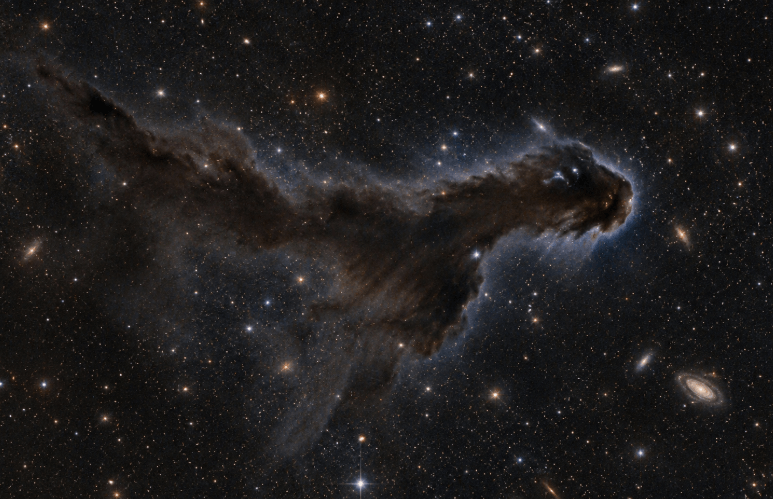
A striking photograph of the Shark Nebula has taken the top honour in the Royal Observatory Greenwich’s Astronomy Photographer of the Year competition, earning photographer Ali Alobaidly the overall prize for 2026.
The winning image, titled The Quiet Predator, was captured in Jahra Governorate, Kuwait, and impressed judges with its detailed portrayal of the dark nebula, which lies around 650 light-years from Earth.
The Quiet Predator Takes Overall Astronomy Prize
The Shark Nebula is a dark nebula formed from interstellar dust so dense that it obscures light from stars behind it. Its distinctive structure has made it a compelling target for astrophotographers seeking to reveal details that are difficult to observe with the naked eye.
Alobaidly’s photograph was entered in the Stars and Nebulae category before being selected as the overall winner of the Royal Observatory Greenwich competition.
Steve Marsh, one of the judges and art editor at BBC Sky at Night Magazine, praised the technical quality of the photograph, saying it demonstrated “flawless presentation, pin-sharp details and dynamic contrast”.
He added: “The Shark Nebula is already a striking object, but when it is resolved to the point where even detail-rich distant galaxies can be seen through it, you know you’re looking at something very special.”
The level of detail captured in the photograph allows viewers to see not only the dark clouds of interstellar material but also more distant objects visible through and around the nebula.
Ali Alobaidly Receives £10,000 Prize
As the overall winner, Alobaidly received a £10,000 prize.
Reflecting on the recognition, he said he hoped to use his photographs “to make astronomy more accessible, engaging and meaningful through science communication and education”, describing the award as a “tremendous honour”.
The 2026 competition attracted almost 4,000 entries from photographers in 66 countries, highlighting the international reach of the annual astronomy photography awards.
Based at the Royal Observatory Greenwich in London, the competition brings together images covering subjects ranging from stars and nebulae to planets, galaxies and other astronomical phenomena.
15-Year-Old Photographer Wins Young Astronomy Award
The competition also recognised emerging talent, with 15-year-old Nikolaos Strimpoulis winning the ZWO Young Astronomy Photographer of the Year award.
His photograph, Mineral Moon, was captured in Palaio Faliro, Athens, Greece.
The close-up image focuses on the lunar surface, offering a detailed view of the Moon and demonstrating the possibilities of astronomical photography even from an urban environment.
Strimpoulis’s success places the young photographer among the latest generation of astrophotographers recognised by the Greenwich competition, which provides a prominent international platform for both established photographers and younger entrants.
Global Competition Celebrates Astrophotography
Astronomy Photographer of the Year has developed into a major showcase for images of the night sky, combining scientific interest with photographic technique and artistic composition.
This year’s thousands of submissions demonstrate how astrophotography continues to attract participants across different countries and age groups, aided by advances in cameras, telescopes and image-processing equipment.
For the 2026 competition, Alobaidly’s view of the Shark Nebula ultimately stood out among nearly 4,000 entries. With its combination of technical precision and astronomical detail, The Quiet Predator secured the competition’s highest honour while highlighting a celestial structure hundreds of light-years beyond Earth.

Edward Langley is a contributor at Mediarunsearch.co.uk, covering a wide range of topics including news, politics, business, technology, sport, entertainment and lifestyle. He focuses on delivering clear, balanced reporting and useful information that helps readers stay informed about current affairs and developing stories. His work highlights issues, trends and events that matter to everyday audiences, with an emphasis on accuracy, relevance and accessible journalism.