
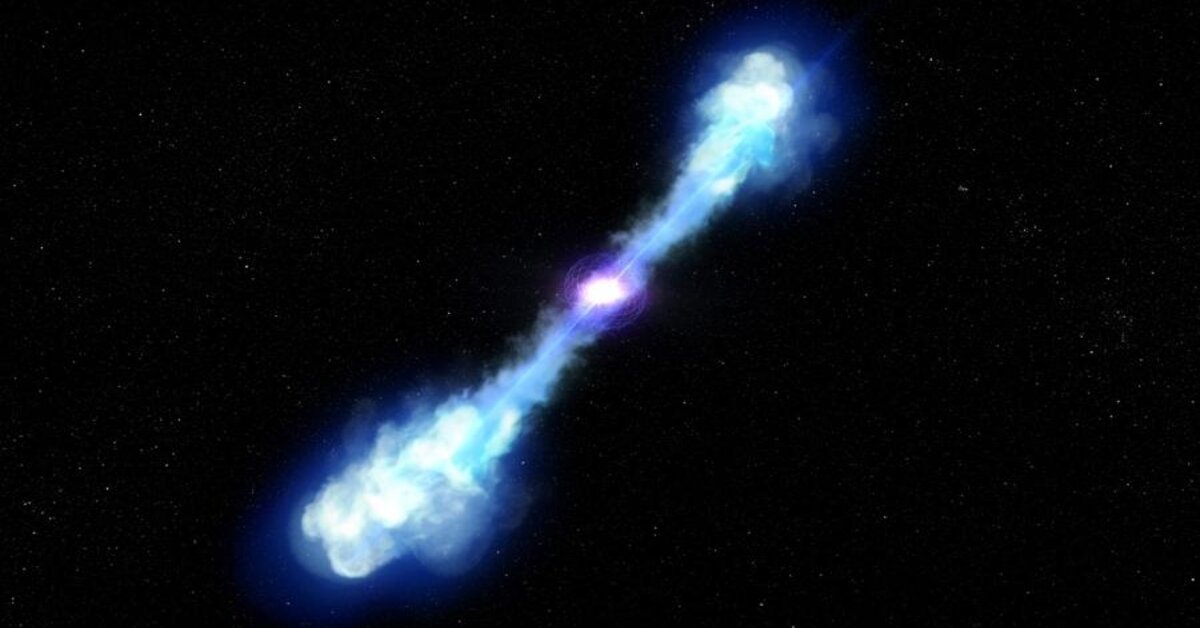
Every now and then, space surprises us with amazing discoveries—mysterious stars, unusual radio bursts, and celestial objects that defy our understanding. Right now, all the attention is focused on a surprising stellar object, possibly a dead star, moving toward the center of the Milky Way at a staggering speed of 1.9 million kilometers per hour.
The hero of this cosmic tale, known as CWISE J1249+3621, lies about 400 light-years from Earth. With a mass about 8% that of the Sun — or 80 times that of Jupiter — this celestial body sits in a border region between the Sun and the more interesting objects called “brown dwarfs.” These dwarfs are often referred to as “failed stars.”

CWISE J1249+3621: The Mysterious Star Traveler
CWISE J1249+3621 was initially identified by citizen scientists associated with the Backyard Worlds: Planet 9 project. Using data from NASA's Wide-field Infrared Survey Explorer (WISE), they discovered this faint object moving close to the Sun, and astronomers then confirmed its existence and astonishing speed with the Keck telescope.
According to Adam Burgasser, the study’s leader and a researcher at the University of California, Berkeley, this brown dwarf is moving so fast that it is not actually bound to the Milky Way. “It is part of a group of ‘ultra-fast’ stars that have been discovered in recent decades. However, what sets it apart is its relative proximity to Earth – just 400 light-years away.”
What makes CWISE J1249+3621 move so fast?
The chemical composition of CWISE J1249+3621 reveals fascinating information about its possible origin. According to the researchers, the atmosphere of this fast-moving object exhibits properties that will be key to solving the mystery of its origins.
For astronomers, the leading hypothesis is the ejection of the supermassive black hole Sagittarius A* at the center of the Milky Way. But there are other theories:
Possible explanations for the speed of CWISE J1249+3621
- Expulsion from the center of the galaxy: The most widely accepted hypothesis is that CWISE J1249+3621 was ejected by the supermassive black hole Sagittarius A*.
- Cosmic Vampire: Another possibility is that the brown dwarf was in a binary system with a white dwarf star, which launched CWISE J1249+3621 at high speed when it exploded.
- Interaction with black holes: CWISE J1249+3621 may have been ejected from a globular cluster due to dynamical interactions with black holes at the cluster's center.
- Galaxy intruder: There is also the possibility that the brown dwarf is an object that came from outside the Milky Way galaxy.
CWISE J1249+3621: A Science Puzzle
What makes CWISE J1249+3621 even more mysterious is its orbit. It moves diagonally in and out of the center of the Milky Way, almost perfectly in the galactic plane. This is in contrast to most high-velocity stars, which typically have more chaotic, tilted orbits.
Scientists believe this feature could be a crucial clue to understanding the true origin of CWISE J1249+3621. “The orbit is certainly the most surprising aspect of this object; it moves radially in and out of the center of the Milky Way, almost perfectly,” the researchers say.
This discovery opens up new opportunities to study brown dwarfs in the Milky Way’s outer reaches, including its core, halo, globular clusters and moons. With further research, we will be able to unravel the mysteries and better understand the processes that drive these stars to move at such extreme speeds.

Edward Langley is a contributor at Mediarunsearch.co.uk, covering a wide range of topics including news, politics, business, technology, sport, entertainment and lifestyle. He focuses on delivering clear, balanced reporting and useful information that helps readers stay informed about current affairs and developing stories. His work highlights issues, trends and events that matter to everyday audiences, with an emphasis on accuracy, relevance and accessible journalism.