
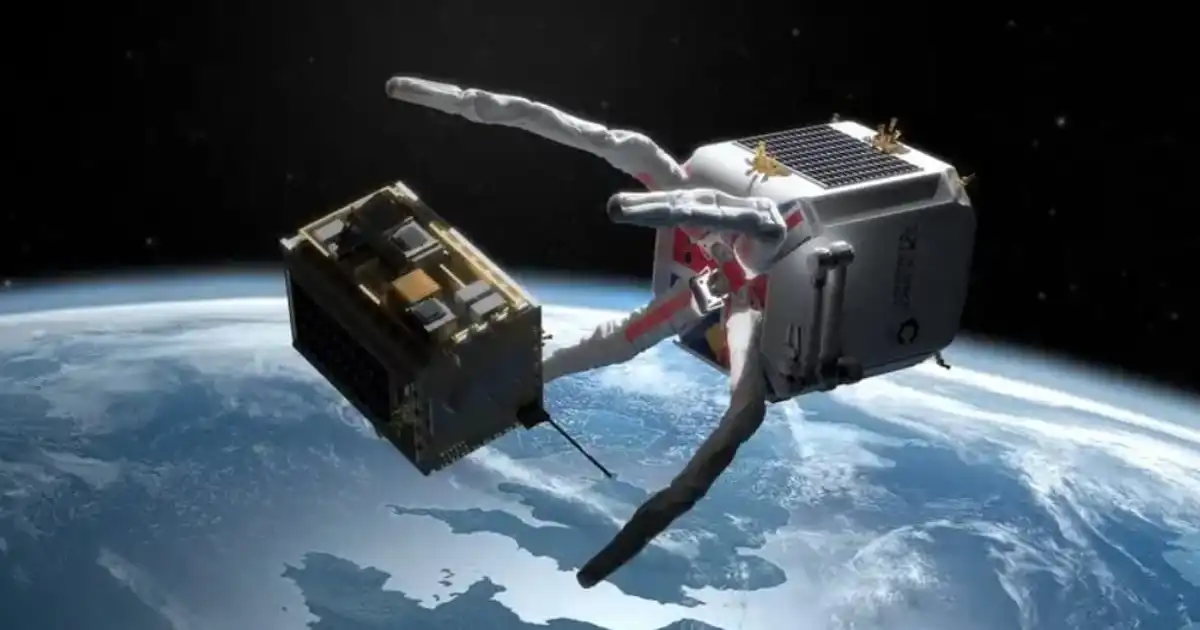
British space mission wants to remove Space trash canTo achieve this, £5 million will be invested in recovering two defunct satellites and returning them to the Earth’s atmosphere to burn up. This will be a first-of-its-kind feat and should be completed within this decade.
The project is part of a commitment to keeping Earth’s orbit clean and tidy, says George Freeman, the UK’s science minister. That also includes setting standards for the safe operation of satellites. “We’re on the cusp of a huge satellite explosion,” he warns. “We want to make sure we lead the way in sustainability science and that the UK becomes a world leader in satellite recovery systems.”
The mission, called the Active Debris Removal Mission, will launch a spacecraft into orbit in 2026. Once there, the craft will travel to decommissioned British satellites and pull them into Earth’s atmosphere to burn them up. The idea is to prove that a single spacecraft can remove more than one piece of debris.
The satellites have yet to be selected, with the UK having more than a dozen inoperable. While there is no legal barrier to any country removing its satellites from space, there are issues that need to be resolved with the Civil Aviation Authority. “What happens if the wrong piece is picked up?” asks lawyer Joan Wheeler, pointing out that there could be safety issues.
How will the work be?
Three companies have put themselves forward for the activity: Swiss ClearSpace, Japan’s Astroscale and British Surrey Satellite Technology (SSTL). Two will be selected in July for a £5m contract. One will then be selected for a contract worth up to £60m.
The companies have different proposals. Astroscale suggests using a robotic arm to grab each satellite. Clearspace recommends using four arms to hug and drop objects. SSTL is considering using a giant net to grab one and an arm to pull the other.
Currently, more than 30,000 pieces of debris are being monitored in Earth orbit – about 2,500 of which are inactive satellites. “Removing multiple pieces with a single vehicle is the right way to go,” says Hugh Lewis, of the University of Southampton. After the mission, the spacecraft will be left in Earth orbit for future use.
It is hoped that this will encourage other debris removal missions. “We are trying to accelerate the development of these technologies,” says Jacob Geer, of the UK Space Agency. “We will send a spacecraft to remove two objects. As a result, there will be less stuff in space. It is a big step for everyone.”

Charlotte Whitmore is a contributor at Mediarunsearch.co.uk, covering a broad range of topics including news, politics, business, technology, sport, entertainment, and lifestyle. She focuses on delivering clear, balanced reporting and practical information that helps readers stay informed about current events and emerging developments. Her work highlights stories that matter to everyday audiences, with an emphasis on accuracy, relevance, and accessible journalism that keeps readers connected to the issues shaping the UK and beyond.