
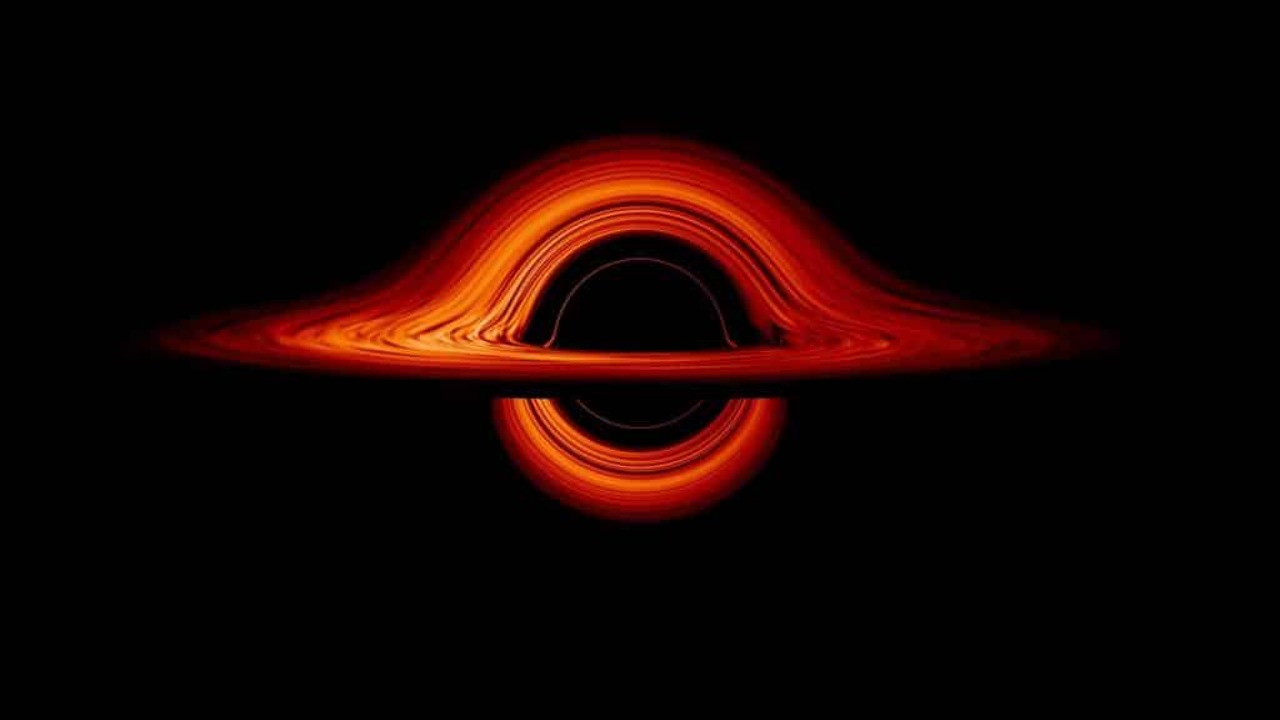
One of the most impressive phenomena in physics and astronomy relates to the emergence and existence of black holes. These anomalies in themselves are a big mystery, because ever since quantum physics was developed, scientists are still looking for many answers about these events in the vast universe.
A group of astronomers made a startling discovery by identifying a “supermassive” black hole with a mass of 33 billion times the mass of the Sun, located hundreds of millions of light-years away.
See also:
The space balloon will provide stratospheric travel in 2025
give priority to seats on the left side of the plane; I know why
According to a study published in the Monthly Notices of the Royal Astronomical Society, this could be one of the largest black holes ever discovered, as it is believed that black holes will not be able to grow much larger than that. Study author James Nightingale said it was difficult to understand the magnitude of this discovery.
To determine the size of this black hole, scientists used a gravitational lensing technique. Massive objects, such as galaxies, can exert a strong gravitational force that bends rays of light. In this way, the galaxies are “separated” and only those in the foreground are analysed.
In this particular case, astronomers looked at images of distant galaxies taken by the Hubble Space Telescope and found a galaxy that was causing this “lensing effect.” Nightingale and his colleagues used computers to determine what type of black hole would be able to create the shape visible in the image, and thus determined the size of the black hole at the center of the galaxy in the foreground, one of the largest ever. discoverer.
This technique can also be used to study inactive black holes, which is not possible in distant galaxies. According to the researchers, the discovery of this supermassive black hole “pushes the boundaries of cosmology” and could help discover more black holes outside the local universe, revealing how these objects have evolved through cosmic time.
What is a black hole?
A black hole is a region of space with such strong gravity that nothing, not even light, can escape. It consists of the collapse of a massive star, in which matter is compressed into an area so small that the gravitational force becomes infinite. For this reason, a black hole is a kind of “hole” in space-time, where the conventional laws of physics do not apply.
This region is called the event horizon, and it is the point of no return, where nothing can escape the black hole’s gravity. Although black holes are not visible, they can be detected by the gravitational effects they have on the objects around them. They are very fascinating and challenging objects for science and astronomy.

Edward Langley is a contributor at Mediarunsearch.co.uk, covering a wide range of topics including news, politics, business, technology, sport, entertainment and lifestyle. He focuses on delivering clear, balanced reporting and useful information that helps readers stay informed about current affairs and developing stories. His work highlights issues, trends and events that matter to everyday audiences, with an emphasis on accuracy, relevance and accessible journalism.