
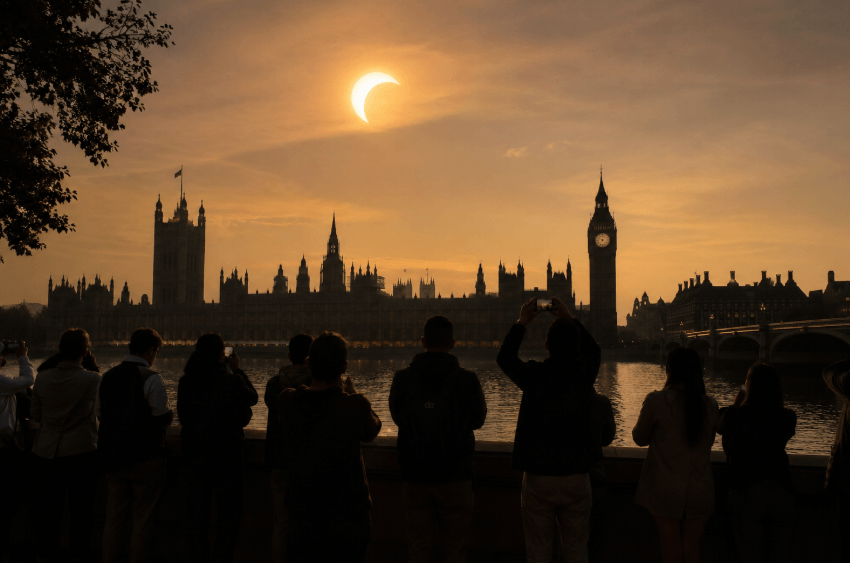
A remarkable partial solar eclipse will be visible across much of the UK on 12 August 2026, offering one of the best opportunities in decades to witness the phenomenon from British skies. While the eclipse will be total over parts of the Atlantic and other regions, observers in London can still expect around 90% of the Sun to be obscured, making it a memorable event for astronomy enthusiasts and casual skywatchers alike.
A Rare Solar Eclipse for UK Skywatchers
According to Royal Museums Greenwich, the August 2026 eclipse will provide the greatest coverage seen across the UK and Ireland since the famous 1999 solar eclipse, when totality was visible from parts of Cornwall and Devon.
Although London will not experience complete darkness, the Moon will cover most of the Sun, causing a noticeable dimming of daylight during the peak of the eclipse.
Eclipse Timings in London
For those watching from the capital:
- First contact: 6:17pm
- Maximum eclipse: 7:12pm
As the event takes place during the early evening, finding a location with an unobstructed view of the western horizon will provide the best viewing conditions. Elevated viewpoints are likely to offer the clearest sightlines.
How to View the Solar Eclipse Safely
Looking directly at the Sun without proper protection can cause permanent eye damage, even during a partial eclipse.
Because the Sun appears dimmer than usual, people may be tempted to look directly at it. However, harmful solar radiation can still reach the retina without causing immediate pain, meaning serious injury can occur before any damage is noticed.
Do Not Use Ordinary Sunglasses
Standard sunglasses, regardless of how dark they appear, do not provide adequate protection for viewing a solar eclipse.
There are two recommended ways to observe the event safely:
Use Certified Eclipse Glasses
If using eclipse glasses or handheld solar viewers, ensure they comply with the ISO 12312-2:2015(E) international safety standard.
Only purchase eclipse glasses from reputable retailers. If there is any doubt about whether the product is certified—or if the lenses are scratched, torn or damaged—it should not be used.
Protecting your eyesight is far more important than risking an unsafe view.
Try Indirect Viewing Methods
You can also enjoy the eclipse without looking directly at the Sun.
Safe methods include:
- Projecting the Sun’s image through the holes of a kitchen colander onto a flat surface.
- Observing the crescent-shaped patches of sunlight created through gaps between tree leaves.
- Making a simple pinhole projector by piercing a small hole in one sheet of paper and allowing the sunlight to project onto another sheet below.
These techniques allow you to watch the eclipse safely without specialist equipment.
Astronomical Societies Hosting Public Viewing Events
Several local astronomy groups are planning organised viewing sessions, with experienced astronomers available to assist visitors and, in many cases, telescopes fitted with appropriate solar filters.
Croydon Astronomical Society
Subject to favourable weather, members will gather at:
- Kenley Airfield
- School Common, Warlingham
- Bingham Recreation Ground, Addiscombe
Flamsteed Astronomy Society
The society will host a public solar viewing event at the Royal Observatory Greenwich. Standard admission charges to the Observatory apply.
Loughton Astronomical Society
Viewing sessions are planned at locations in Chingford and Theydon Bois, with certified eclipse glasses available to borrow.
Hampstead Scientific Society
No public event has been confirmed yet, although the society is expected to announce arrangements closer to the eclipse date if weather conditions are favourable.
South London Astronomical Society
A public event will take place at Riddlesdown Common, Purley, featuring:
- Eclipse glasses available to borrow
- Three specialist solar telescopes
- Local astronomers available to answer questions
Entry costs £10 per family (up to five people).
SW London Stargazers
The local Meetup group will gather in Tooting Bec to observe the eclipse together.
Other Astronomy Groups Worth Checking
Several organisations had not confirmed public events at the time of publication but may announce viewing opportunities nearer the date:
- Orpington Astronomical Society
- West of London Astronomical Society
- Ewell Astronomical Society
- Crayford Manor House Astronomical Society
A Memorable Evening for UK Astronomy Enthusiasts
With around 90% of the Sun expected to be covered in London, the 12 August 2026 partial solar eclipse promises to be one of the UK’s most significant astronomical events in more than a quarter of a century. Whether watching independently using safe viewing techniques or attending a local astronomy event, careful preparation and proper eye protection will ensure the eclipse can be enjoyed safely.

Edward Langley is a contributor at Mediarunsearch.co.uk, covering a wide range of topics including news, politics, business, technology, sport, entertainment and lifestyle. He focuses on delivering clear, balanced reporting and useful information that helps readers stay informed about current affairs and developing stories. His work highlights issues, trends and events that matter to everyday audiences, with an emphasis on accuracy, relevance and accessible journalism.