
- author, Michelle Roberts
- scroll, BBC News Digital Health Editor
A British girl who was born deaf can now hear without any help after undergoing pioneering gene therapy.
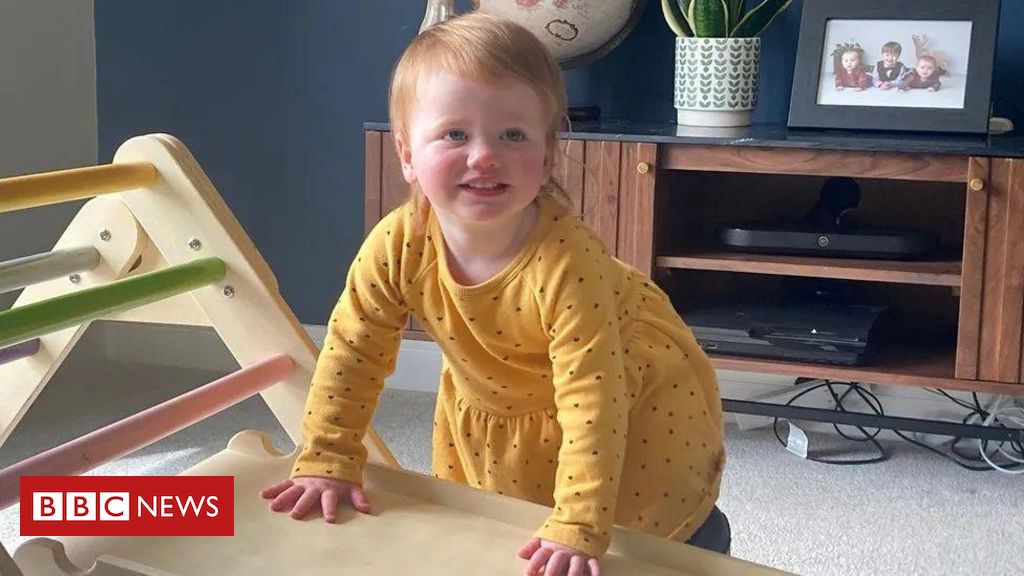
Opal Sandy received treatment just before her first birthday. After six months, he can hear soft sounds like a whisper, and begin to speak, saying words like “mama” and “daddy.”
This treatment is administered in the form of an injection into the ear, where it replaces the defective DNA that causes hereditary type of deafness.
Opal is participating in a clinical trial recruiting patients in the UK, US and Spain. The treatment was developed by the biotechnology company Regeneron.
Doctors in other countries, including China, are also exploring similar treatments for the otoferlin (OTOF) gene mutation that Opal was born with.
His parents, Joe and James, from Oxfordshire in south-east England, say the results have been impressive.
At the same time, allowing Opal to be the first to test this treatment was an extremely difficult decision, they said.
“It was very scary, but I think we had a unique opportunity,” Joe says.
Opal's five-year-old sister, Nora, has the same type of deafness and is adapting well to a cochlear implant.
Instead of making the sound louder, like a hearing aid, it gives the “feeling” of being heard.
The implant stimulates the auditory nerve that communicates directly with the brain, bypassing damaged, sound-sensitive hair cells in a part of the inner ear known as the cochlea.
Gene therapy uses a modified, harmless virus to deliver a functional copy of the OTOF gene to these cells.
Opal underwent treatment on her right ear under general anesthesia and a cochlear implant was placed in her left ear.
After just a few weeks, she was able to hear loud sounds, such as clapping, in her right ear.
Six months later, his doctors at Addenbrooke's Hospital in Cambridge confirmed that he had almost normal hearing for quiet sounds, including soft whispers.
Hearing surgeon Manohar Bance, the lead researcher on the clinical trial, told BBC News: “It's great to see her responding to sound.”
“It is a moment of great joy.”
Experts hope the treatment will also work for other types of profound hearing loss.
More than half of hearing loss cases in children have a genetic cause.
Pance expects that the clinical trial could lead to the use of gene therapy for the most common types of hearing loss.
“What I hope is that we can start using gene therapy in young children… where we actually restore their hearing and they don't need cochlear implants and other technologies that need to be replaced,” he says.
credit, Joe and James Sandy
Hearing loss caused by a variation in the OTOF gene is not commonly detected until children are 2 or 3 years old, when speech delays are likely.
Genetic testing for families at risk is available on the NHS (the UK public health system). BBC News Brasil is investigating whether the treatment is also available in the Brazilian system.
“The faster we can restore hearing, the better for all children, because the brain begins to reduce its plasticity [adaptabilidade] “After three years of age or so,” Bance says.
The OPAL trial, along with other scientific data from the clinical trial, is being presented at the American Society for Gene and Cell Therapy (ASGCT), in Baltimore, USA.
Martin McLean, of the UK's National Deaf Children's Society, says more options would be welcome.
“With the right support from the start, deafness need not be a barrier to happiness or fulfillment,” he says.
“As a charity, we support families to make informed choices about medical technologies so they can give their deaf children the best possible start in life.”
*Additional reporting by Nikki Steastny and James Anderson

Charlotte Whitmore is a contributor at Mediarunsearch.co.uk, covering a broad range of topics including news, politics, business, technology, sport, entertainment, and lifestyle. She focuses on delivering clear, balanced reporting and practical information that helps readers stay informed about current events and emerging developments. Her work highlights stories that matter to everyday audiences, with an emphasis on accuracy, relevance, and accessible journalism that keeps readers connected to the issues shaping the UK and beyond.