
Continues after ad
A wave trace from a time when the universe was dark has been detected in a large cluster of galaxies, adjacent to the cluster in which the Milky Way is located. This discovery will help us learn more about what our universe was like at a time when light was not able to travel freely.
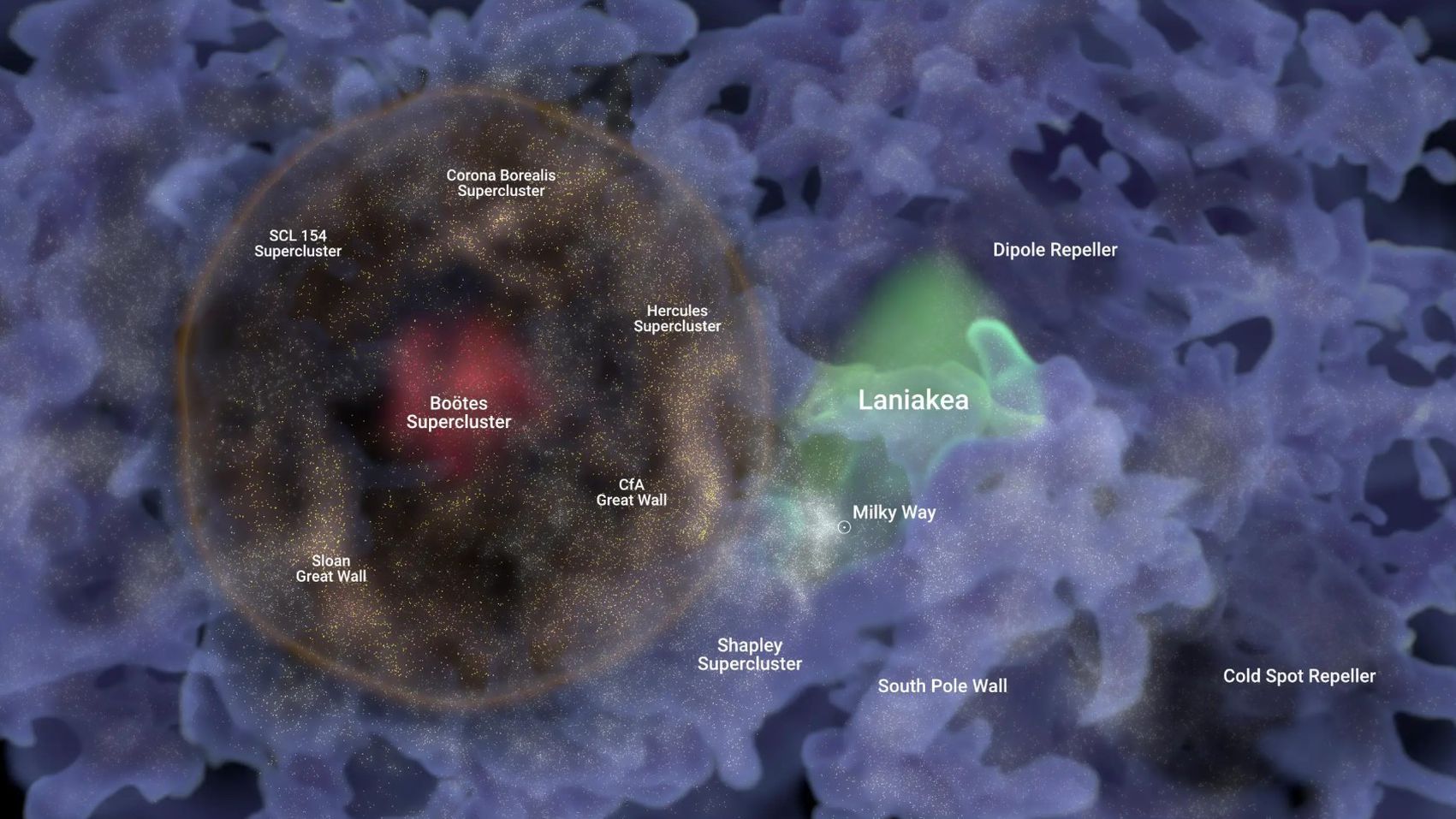
Next to our giant galaxy cluster, called Laniakea, there is a kind of bubble about a billion light-years in diameter. This is a baryonic acoustic oscillation (BAO), a type of imprint left on matter in the universe by an acoustic oscillation that occurred shortly after the Big Bang.
This BAO is named Hoʻoleilana, a term that refers to a Hawaiian song about creation. The new study team says this may be the first time a single structure associated with BAO has been identified. “It is so large that it reaches the edges of the strip of sky we were analyzing,” said research leader Brent Tully.
Continues after ad
In the video below, we see the 3D shape of the structure, just as theory predicts.
Baryonic acoustic oscillations
When the universe was less than 370,000 years old and had a temperature of about 3,000 K, photons and matter were strongly coupled in a plasma. Astrophysicists say the universe was dark at that time because photons were unable to travel far without being absorbed by atoms of elements like deuterium.
About 370,000 years after the Big Bang, the universe became cool enough to form neutral atoms (such as hydrogen), and photons began to travel freely, making the universe transparent for the first time. In other words, radiation and matter were separated.
In this process, photon interactions with new atoms are transmitted in the form of cosmic microwave background radiation, one of the main pieces of evidence for the hot Big Bang model. But this wasn’t the only fossil record of the early universe: there were also sound waves transmitted through plasma.
In general, we say that sound does not propagate in space, and this is for a very obvious reason: sound waves cannot propagate where there is no matter, such as the atmospheric gases found on our planet. But when the universe was a “soup” of opaque plasma, the oscillations that make up sound waves could propagate smoothly.
Continues after ad
On the other hand, when the universe became transparent, these oscillations ceased to exist, as the radiation began to spread widely. However, sound waves are imprinted everywhere in the universe as matter sticks together to form galaxies and galaxy clusters.
These impressions are BAOs and, according to theory, should have the shape of a bubble. Their sizes must always be approximately the same, and are limited by the speed and range that sound waves can travel in the plasma.
Tully and his team said they weren’t looking for BAOs, but were lucky to find them. It could reveal important details about the early universe, and since the distance between the bubble and the Milky Way appears smaller than expected, this discovery could reveal the expansion rate of the universe.
The article was published in Astrophysical Journal.
Continues after ad

Edward Langley is a contributor at Mediarunsearch.co.uk, covering a wide range of topics including news, politics, business, technology, sport, entertainment and lifestyle. He focuses on delivering clear, balanced reporting and useful information that helps readers stay informed about current affairs and developing stories. His work highlights issues, trends and events that matter to everyday audiences, with an emphasis on accuracy, relevance and accessible journalism.