
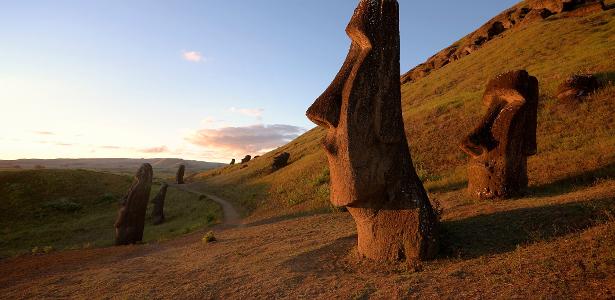
The researchers relied on “a new and evolving stock of innovative rock gardens” where the Rapa Nui tribe grew potatoes, a staple of their diet.
According to scientists, the surface of these crops could only support about 2,000 or 3,000 people, the number found by Europeans when they arrived on the island in the 18th century, and not the 17,500 or 25,000 estimated so far on the basis of labor need. The famous Moise Sculpture, giant stone sculptures.
Scientists have searched for decades for why the civilization that created these monoliths disappeared. “This shows that the population could not have been as large as some previous estimates were,” said Dylan Davis, the study's lead author and a researcher at Columbia University.
“The lesson flies in the face of collapse theory,” Davis explained. “People were able to be very resilient in the face of limited resources by modifying the environment in a way that helped.”
Formed from volcanic rock, Easter Island is perhaps the most remote inhabited place on Earth and one of the last places to be colonized. About 5,000 kilometers to the west are the Cook Islands, from where colonists are believed to have sailed around 1200 AD.
To protect themselves from adverse conditions, early settlers used a technique of spreading stones on low surfaces to protect crops from salt spray and wind. With the help of artificial intelligence, the researchers studied the rock gardens and their characteristics in the field for five years.

Oliver Ashford is a contributor to Mediarunsearch.co.uk, covering a broad range of topics including news, politics, business, technology, sport, entertainment and lifestyle. He focuses on delivering clear, balanced reporting that helps readers stay informed about current affairs and developments that matter. With an emphasis on accuracy, relevance and accessibility, Oliver aims to present useful information and engaging stories in a straightforward manner, making complex topics easier for readers to understand and follow.