
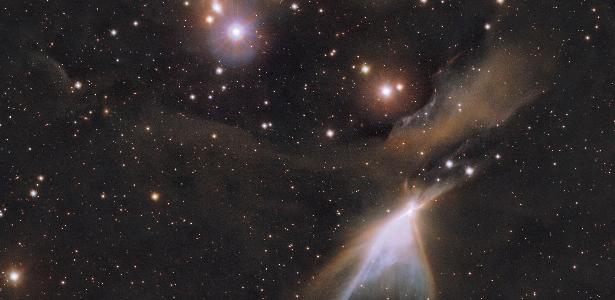
An international team of scientists led by Stefan Mengast of the University of Vienna in Austria last week released some of the most complete infrared images ever taken of our region’s stellar nurseries.
The project, which observed nebula regions in Orion, Ophiuchus, Chameleon, Coroa Australis, and Lupus, counted on 50 hours of the European Southern Observatory’s Vista telescope, collecting more than 1 million individual images, roughly 20 terabytes of data.
Star nurseries are large clouds of gas and dust from which new stars are forming. Thus, by studying these regions, we hope to better understand the star birth process by directly investigating the youngest stars and the medium in which they are formed.
It is interesting to emphasize the importance of the type of radiation observed. By obtaining infrared images, astronomers were able to reduce the problem caused by the large amount of dust in these clouds, which blocks the visible light produced by the stars within them. Thus, we can directly obtain information about what is happening in the heart of these clouds.
In addition to the detailed composition, covering from the center of the regions to their outskirts, the project also had temporal coverage: by observing the stars for five years, between 2017 and 2022, the team was able to observe their motion, and better describe it. Physical processes inside clouds.
In this way, the project also serves as a complement to the European Space Agency’s Gaia satellite. Although Gaia can more accurately determine the motion of stars in our galaxy, its visible camera is unable to penetrate the dust layer and observe the interiors of stellar nurseries.
An interesting point about this project is its community character: it is what we call a public survey.
Rather than obtaining data that only the original science team would use, it produces images and catalogs of data that are available to anyone who wants to access it online.
So, while it’s a relatively high investment of resources – after all, it’s been a lot of nights for a relatively large telescope – the expected return is also high.
Scientists around the world can use the data in different ways, which greatly increases the discoverability of the images.
This way of doing science has become increasingly popular since the beginning of the 21st century. Officials and politicians have noticed that this model is capable of achieving much more results in a given period, allowing for the free development of ideas from the same set of observations.
Will this be the way of the future, making the exchange of information between scientists more free?
It is undoubtedly a democratic path, helping to break down barriers that prevent researchers from countries with less access to resources from accessing data from more advanced telescopes.

Edward Langley is a contributor at Mediarunsearch.co.uk, covering a wide range of topics including news, politics, business, technology, sport, entertainment and lifestyle. He focuses on delivering clear, balanced reporting and useful information that helps readers stay informed about current affairs and developing stories. His work highlights issues, trends and events that matter to everyday audiences, with an emphasis on accuracy, relevance and accessible journalism.