
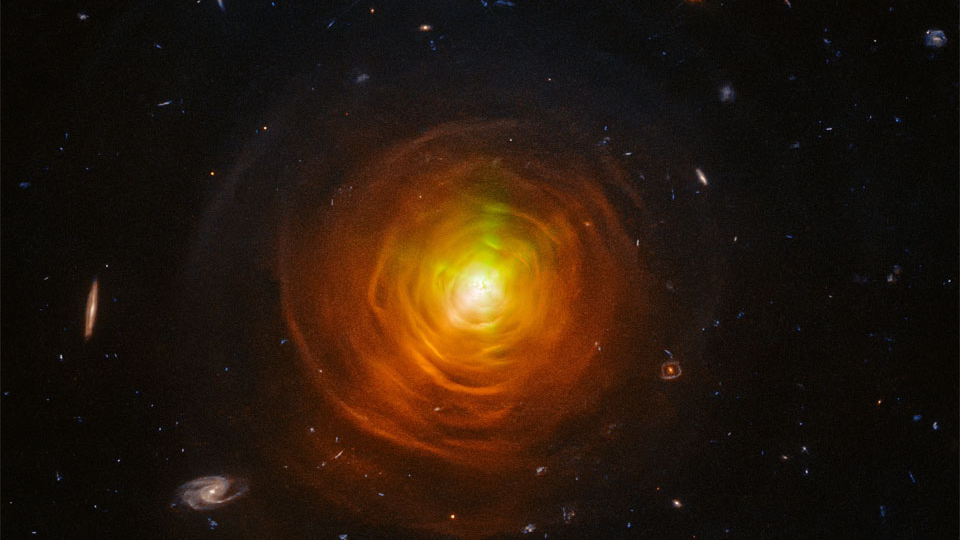
The star CW Leonis appears in an astronomical image highlighted by NASA on Monday (17), in an image captured by the Hubble Telescope. It is 400 light years away from us, and it is considered the closest carbon star to Earth.
This star appears to be surrounded by a gaseous cloud rich in carbon, with a structure of arcs and envelopes. It is not known for sure what is behind the structure, and you can check it out in the image below:
The star’s orange color is the result of atmospheric carbon coming from the star’s interior through nuclear fusion. Due to their lower gravity, these stars are able to release carbon and derived compounds into space more efficiently.
In addition to the orange shell, the star has another strange feature: there are rays of light in it, the intensity of which has changed in brightness over a period of only 15 years. The time is very short in astronomical terms, and it was caused by a process that is unknown at the moment.
What is a carbon star?
To understand carbon stars, one must first recall the processes in stars of medium mass. When they exhaust their reserves of hydrogen for nuclear fusion, the star collapses and eventually becomes a red giant.
Most carbon stars are of this type, which partly explains their reddish hue. Another reason lies in the outer layers of these stars, which scatter blue-green light. Only red and orange light can cross the barrier and reach our eyes.
Also, carbon stars are variable, which means that the intensity of their light changes periodically. This difference can occur within a few months, but it can also take more than a year.
source: APOD

Edward Langley is a contributor at Mediarunsearch.co.uk, covering a wide range of topics including news, politics, business, technology, sport, entertainment and lifestyle. He focuses on delivering clear, balanced reporting and useful information that helps readers stay informed about current affairs and developing stories. His work highlights issues, trends and events that matter to everyday audiences, with an emphasis on accuracy, relevance and accessible journalism.