
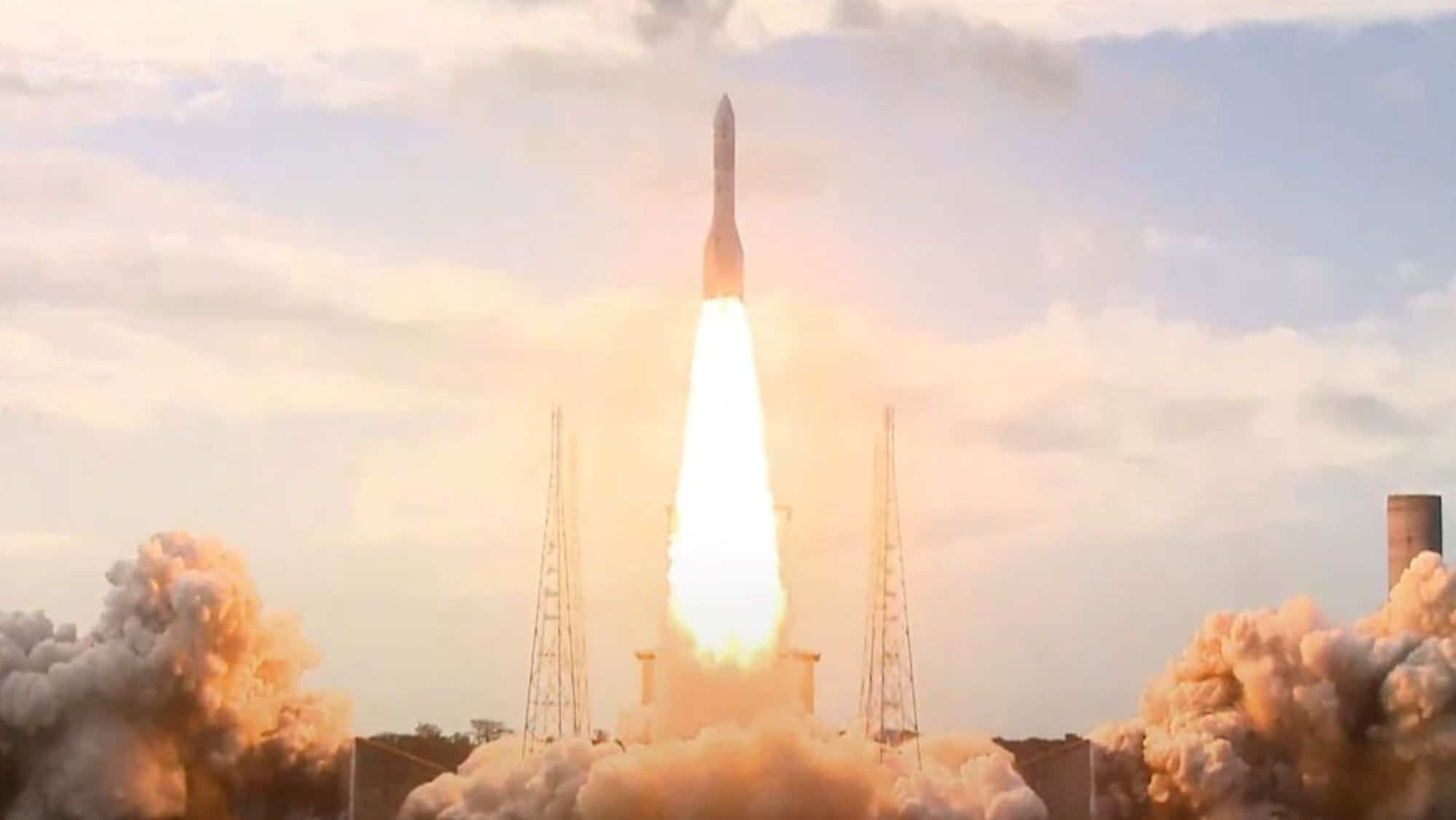
After several delays and much anticipation, Ariane 6 finally made its first flight. The rocket took off at 4:01 p.m. (Brasilia time) on Tuesday (9), directly from the European Spaceport in French Guiana.
How was the first flight of Ariane 6?
The first launch of Ariane 6 is primarily a test flight. It carries eight cubesats from companies and organizations and five payloads that will remain attached to the rocket’s upper stage. It will also deploy two reentry capsules, one developed by ArianeGroup and the other by Exploration Company, a European startup that recently won an ESA award to build a commercial cargo spacecraft.
The most important part of the launch is the vehicle itself. The Ariane 6 rocket is a key element in Europe’s efforts to end the “launch crisis” that has temporarily deprived it of independent access to space.

The crisis resulted from delays in the launch of the Ariane 6 rocket and the retirement of the Ariane 5, as well as the loss of the Soyuz rocket after the Russian invasion of Ukraine in 2022 and the failed launch of Vega C later that year.
“Ariane 6 represents a new era of independent and versatile European space travel,” said Josef Aschbacher, ESA’s Director General. “This powerful rocket is the culmination of many years of dedication and ingenuity by thousands of people across Europe, and with its launch it will re-establish Europe’s independent access to space.”
Read more:
Missions awaiting the European Ariane 6 rocket
Ariane 6 is the evolution of the successful Ariane 5, which played a crucial role for Europe for 27 years. Between 1996 and 2023, the spacecraft carried out 117 launches, 112 of which were successful. It was, for example, the one that sent the James Webb Space Telescope (JWST) into space at Christmas 2021.
Developed by French company Arianespace, Ariane 6 will be longer but lighter, and each launch will cost less than its predecessor.

ESA has a number of exciting missions lined up for Ariane 6. One will be the advanced PLATO (Planetary Transits and Oscillations of Stars) observatory, which will search for habitable worlds around sun-like stars. It is due to launch in 2026.
A related but smaller mission is the Atmospheric Infrared Remote Sensing Survey of Large Exoplanets (ARIEL), which will devote its time to studying the atmospheres of about a thousand known worlds outside the solar system, building on Webb's progress.
ARIEL is scheduled to launch in 2029, alongside the complementary Comet Interceptor mission, a spacecraft that will remain parked in space far from Earth. When a comet from the far reaches of the solar system (or even an interstellar object) approaches, it will be activated to intercept and study this still-unknown object. A truly unique mission.

Edward Langley is a contributor at Mediarunsearch.co.uk, covering a wide range of topics including news, politics, business, technology, sport, entertainment and lifestyle. He focuses on delivering clear, balanced reporting and useful information that helps readers stay informed about current affairs and developing stories. His work highlights issues, trends and events that matter to everyday audiences, with an emphasis on accuracy, relevance and accessible journalism.