
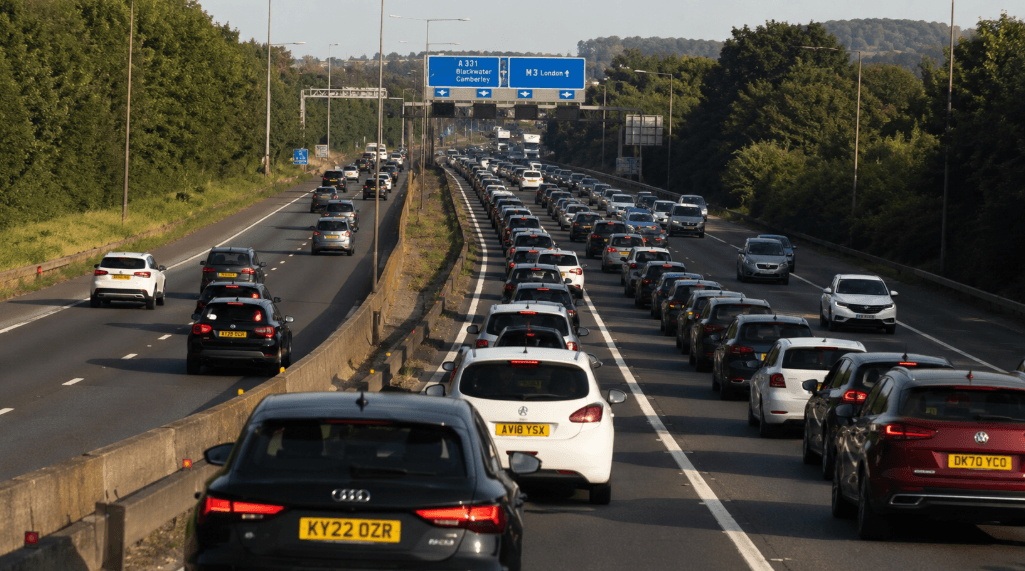
Nearly 19 Million Drivers Expected on UK Roads During Half-Term Getaway
Britain is preparing for one of the busiest late May bank holiday weekends in recent years, with soaring temperatures, half-term school breaks and strong demand for domestic and overseas travel expected to put major pressure on roads, airports and rail services across the country.
Motoring organisations have warned that almost 19 million motorists are likely to travel over the long weekend, with coastal routes, motorway networks and key holiday corridors forecast to experience severe congestion from Friday onwards.
Forecasters say temperatures could climb above 30C by Monday in parts of England, creating conditions more typical of mid-summer than the end of May.
Coastal Routes and Motorways Expected to Face Heavy Congestion
The RAC estimates that traffic volumes will exceed those seen during the same bank holiday period last year by around one million journeys.
Its research found that nearly four in ten motorists are planning leisure trips over the weekend, with Friday and Saturday expected to be the busiest days on the roads.
Popular seaside destinations are likely to attract particularly heavy traffic as families take advantage of the warm weather during the school half-term break observed in several parts of the UK.
Long queues are expected on routes leading to Cornwall, the south coast and holiday resorts in eastern and north-west England. Roads predicted to experience significant delays include the A303, M5, A38, M1, M25 and M6.
The AA said many travellers are opting for day trips to coastal towns rather than extended overnight breaks. Shopping centres and retail parks are also expected to generate substantial traffic volumes across urban areas.
Parking operator RingGo reported that historical data from previous bank holiday weekends points to Saturday being the peak day for seaside travel, with Bournemouth regularly seeing one of the sharpest increases in visitor numbers.
Fuel Prices Continue to Affect Travel Decisions
Despite strong demand for travel, rising fuel prices remain a concern for many households.
According to RAC figures, the average petrol price across the UK has risen to 158.52p per litre — the highest level recorded since December 2022.
Around 5% of drivers surveyed said higher motoring costs would discourage them from travelling over the bank holiday weekend.
The combination of elevated fuel prices and ongoing pressure on household finances continues to shape holiday decisions for many families, even as demand for short breaks remains resilient.
Dover Border Delays Add Pressure to Holiday Traffic
The Port of Dover is also expected to experience significant disruption as thousands of travellers head to continental Europe.
Approximately 18,000 passengers are scheduled to pass through the port between Friday and Sunday, with Saturday morning forecast to be the busiest departure period.
Travellers have been warned to prepare for lengthy waits linked to the European Union’s new Entry/Exit System (EES). Although new processing kiosks have been installed at Dover, the French border system is not yet fully operational, meaning manual passport checks are still being carried out.
Reports on Friday morning suggested some travellers were already experiencing processing delays of up to an hour from as early as 6am.
UK Airports Brace for Busy Half-Term Departures
Airports across the UK are also preparing for a surge in passenger numbers despite concerns surrounding aviation fuel supplies linked to tensions involving Iran.
Industry estimates suggest as many as two million passengers could depart from UK airports during the coming days.
Travel trade association Abta said demand for half-term holidays remains strong, particularly for Mediterranean destinations including Spain, Portugal, Italy, Croatia and Greece.
Mark Tanzer, chief executive of Abta, said: “In the face of economic and geopolitical challenges, people are still getting away on their holidays this May and making the most of some excellent deals.”
Aviation analytics firm Cirium said more than 12,000 flights are scheduled to leave UK airports over the bank holiday weekend, offering over two million seats.
Friday is expected to be the busiest day for air travel, with Dublin ranking as the top destination, followed closely by Palma de Mallorca.
Rail Passengers Face Disruption Despite Most Services Running
While most of Britain’s rail network will remain operational throughout the weekend, passengers have been warned about disruption caused by planned engineering works and industrial action.
Network Rail confirmed that around £64 million worth of maintenance and upgrade work is taking place across the network during the holiday period.
Parts of the East Coast Main Line between London and Edinburgh will be affected, with replacement bus services operating between York and Darlington from Saturday through Monday.
On the Great Western route, buses will replace trains between Newport and Bristol Parkway.
Meanwhile, Thameslink services will not operate through central London, requiring passengers to begin or end journeys at either King’s Cross St Pancras or London Bridge.
Industrial action is also expected to affect services in the Midlands and on routes linking Birmingham, Liverpool and London, after members of the TSSA union announced strikes involving West Midlands Railway and London Northwestern Railway.
A Challenging Start to the Summer Travel Season
The combination of unusually hot weather, school holidays and continued enthusiasm for domestic and overseas breaks is set to create one of the busiest travel weekends Britain has seen so far this year.
With congestion expected across roads, ports, airports and rail networks, transport officials are urging travellers to allow extra time, check routes in advance and prepare for delays throughout the bank holiday period.

Edward Langley is a contributor at Mediarunsearch.co.uk, covering a wide range of topics including news, politics, business, technology, sport, entertainment and lifestyle. He focuses on delivering clear, balanced reporting and useful information that helps readers stay informed about current affairs and developing stories. His work highlights issues, trends and events that matter to everyday audiences, with an emphasis on accuracy, relevance and accessible journalism.