
Close Menu
    Facebook X (Twitter) Instagram
    Trending
    • Ogor Mawtribes Gain Powerful New Rules in Upcoming Warhammer Age of Sigmar Battletome
    • Excel World Championship Goes Global as Competitors Tackle Puzzles in the Open Air
    • South East Water Ordered to Fund £30.5 Million Improvement Programme Following Major Supply Failures
    • Adobe Expands User Control Over AI Tools in Lightroom and Photoshop
    • Monitor Audio Radius Series 4G Launches With Ambitions to Redefine Compact Hi-Fi Sound
    • Anthropic to Hold White House Talks After AI Tool Suspension
    • Rayman Legends Retold Confirmed For October Release On Xbox Series X|S
    • Microsoft Tests AI Wearable Devices Designed for Office Workers
    Mediarun Search
    • Home
    • Top News
    • World
    • Economy
    • Science
    • Technology
    • Sport
    • Entertainment
    • Contact Us
    Mediarun Search
    Home»Tech»An object 10 times brighter than the Sun defies the laws of astrophysics
    Tech

    An object 10 times brighter than the Sun defies the laws of astrophysics

    Edward LangleyBy Edward LangleyMay 12, 2023No Comments2 Mins Read
    Facebook Twitter Pinterest LinkedIn Tumblr Email
    An object 10 times brighter than the Sun defies the laws of astrophysics
    Share
    Facebook Twitter LinkedIn Pinterest Email

    NASA has been searching for ultra-bright X-ray sources for some time now, and its latest discovery has astounded the world of astrophysicists and astronomers.

    Ultraluminous X-ray sources are astronomical objects that emit a huge amount of X-rays, usually found in distant galaxies and considered rare. It emits 10,000 times more energy than the sun.

    This even breaks a concept in astrophysics known as the “Eddington limit,” which refers to the maximum amount of radiation a star can emit without compressing that radiation making the star itself unstable. The limit is determined by the relationship between the mass of the star and its luminosity and, If it exceeds this limit, the star is expected to explode into several pieces.

    In new notes posted on Astrophysical JournalNASA confirmed that the ULX in particular – called M82 X-2 – may push Eddington’s limit. The analysis noted that ULX extracted about 9 trillion tons of material annually from a neighboring star, which means that its brightness is caused by an abnormal amount of material that exceeds a threshold.
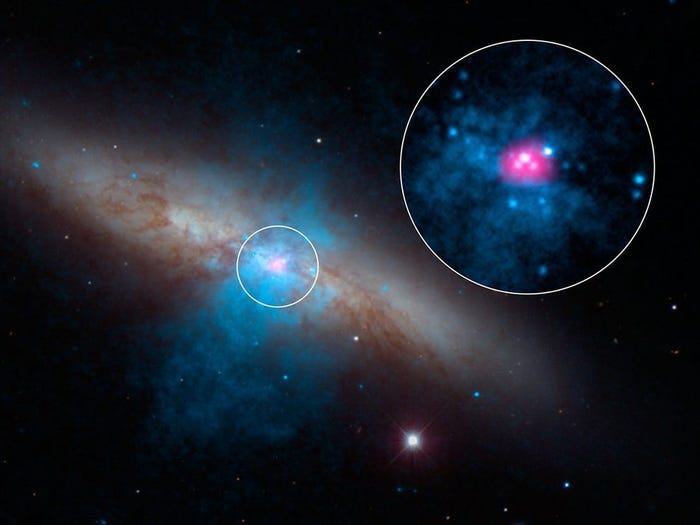
    An ultra-bright X-ray source called M82 X-2 within the Messier 82 galaxy. (NASA/JPL-Caltech/SAO/NOAO)An ultra-bright X-ray source called M82 X-2 within the Messier 82 galaxy. (NASA/JPL-Caltech/SAO/NOAO)source: NASA

    ULX is formed from neutron stars, which are the dead nuclear remnants of stars like the Sun. A neutron star is so dense that gravity on its surface is about 100 trillion times stronger than Earth’s. This means that any matter drawn to the dead star’s surface will be blown away.

    Scientists around the world have theories about ULX that defy the rules of astrophysics. said Matteo Pacchetti, astrophysicist and study author.

    See also  PS Plus September | When is the announcement of free games?
    Edward Langley

    Edward Langley is a contributor at Mediarunsearch.co.uk, covering a wide range of topics including news, politics, business, technology, sport, entertainment and lifestyle. He focuses on delivering clear, balanced reporting and useful information that helps readers stay informed about current affairs and developing stories. His work highlights issues, trends and events that matter to everyday audiences, with an emphasis on accuracy, relevance and accessible journalism.

    Share. Facebook Twitter Pinterest LinkedIn Tumblr Email

    Related Posts

    Excel World Championship Goes Global as Competitors Tackle Puzzles in the Open Air

    July 14, 2026

    Adobe Expands User Control Over AI Tools in Lightroom and Photoshop

    June 16, 2026

    Monitor Audio Radius Series 4G Launches With Ambitions to Redefine Compact Hi-Fi Sound

    June 16, 2026
    Leave A Reply Cancel Reply

    Navigate
    • Home
    • Top News
    • World
    • Economy
    • Science
    • Technology
    • Sport
    • Entertainment
    • Contact Us
    Pages
    • About Us
    • Contact Us
    • DMCA
    • Editorial Policy
    • Privacy Policy
    © 2026 Media Run Search. All Rights Reserved. Designed by Media Run Search.

    Type above and press Enter to search. Press Esc to cancel.