
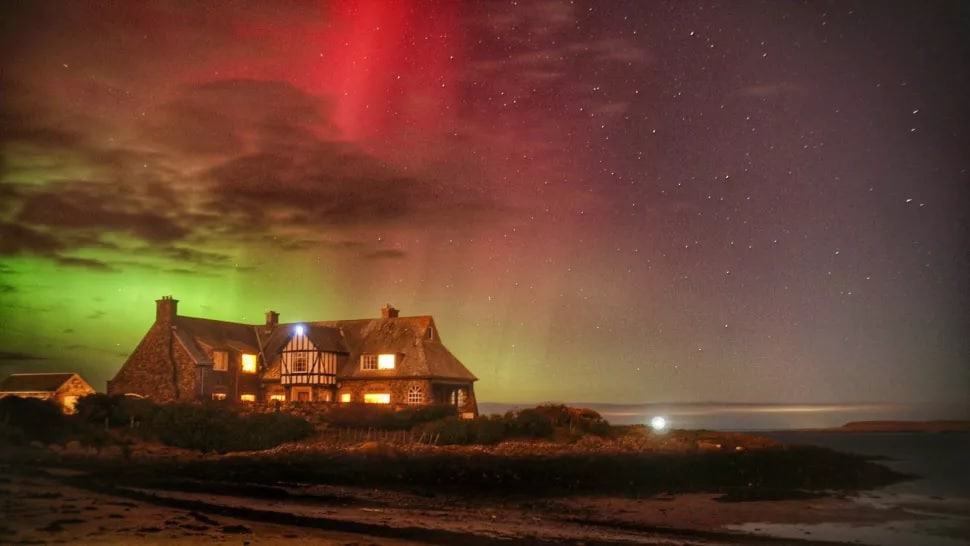
A stream of solar plasma has reached Earth in recent days, overloading the atmosphere with solar wind particles that have created auroral displays across large swathes of the UK, a region where such events are extremely rare.
Several records taken this morning have been shared on social media, and meteorologists predict that more displays of this kind are on the way, as an explosion generated by another solar flare is expected to hit our planet on Monday (27).
One of the most impressive shots was captured on board a plane approaching London Heathrow Airport from Billund, Denmark.
Passenger Ben Aplin posted: “Great views of the Northern Lights last night on a British Airways flight from Billund to Heathrow.” “Thanks to the pilot who turned off the lights so we could capture this moment! I got a few time lapses and the result was great.
For the first time, photographer Ivan Boyce from Northern Ireland witnessed a night of chasing the Northern Lights, producing stunning results on his first hunt.
“I picked up a camera for the first time during the coronavirus lockdown and have wanted to capture the aurora ever since,” Boyce told the site. Space.com website By email. “It is very difficult to live in Northern Ireland because we are so far south compared to where the aurora can usually be seen.”
He added that all his previous attempts to capture the aurora borealis had failed due to the cloudy weather. On Sunday night (26), Boyce drove to the beach between the cities of Bangor and Donaghadee, a short drive from the capital, Belfast. There, he was able to record a mysterious green and red glow above a historic building, against the backdrop of a starry sky.

“I can't believe how lucky I was,” Boyce said. “Judging by the reaction of other local photographers, the power and color of last night was a rare event.”
Astrophotographer Stuart Atkinson, who lives in the famous Lake District Nature Park in northwest England, was finally able to capture intense red lights after what he described as a “frustrating twilight chase” spoiled by the weather.

“I got the images last night from a place called Shab, which is probably one of the highest places in my area and far enough north of where I live to give me a better view of the aurora than I would have gotten at home,” Atkinson said. “Conditions last night were pretty bad at first, almost completely cloud out, but after an hour or so a big gap appeared and I was able to take some pictures.”
Read more:
There have also been reports of aurora sightings from Canada and the US states of Alaska, Ohio and New York.
https://twitter.com/madisongnielsen/status/1630300314845986817
According to the UK's space weather forecasting service, the Met Office, the scene was the result of a coronal mass ejection (CME), a powerful explosion of solar plasma from an active region, or sunspot, that erupted from the Sun on Friday (24).
The colors visible in auroral displays result from specific interactions between molecules in the solar wind and chemical compounds in the air. “Different gases glow differently,” said Afelia Wibisono, an astronomer at the Royal Observatory in Greenwich. “Oxygen glows green, and nitrogen emits blue and violet. If these incoming charged particles are particularly active, oxygen at high altitudes may also emit a deep red color and nitrogen may glow pink.”
Aurora hunters are on edge tonight as another, more powerful CME is ready to arrive. The Met Office is forecasting a powerful G3 geomagnetic storm, which as well as producing more impressive auroral displays, could also cause minor problems for satellite operators and power grids in northern latitudes.
Have you watched the new videos on Youtube From Olhar Digital? Subscribe in the channel!

Charlotte Whitmore is a contributor at Mediarunsearch.co.uk, covering a broad range of topics including news, politics, business, technology, sport, entertainment, and lifestyle. She focuses on delivering clear, balanced reporting and practical information that helps readers stay informed about current events and emerging developments. Her work highlights stories that matter to everyday audiences, with an emphasis on accuracy, relevance, and accessible journalism that keeps readers connected to the issues shaping the UK and beyond.