
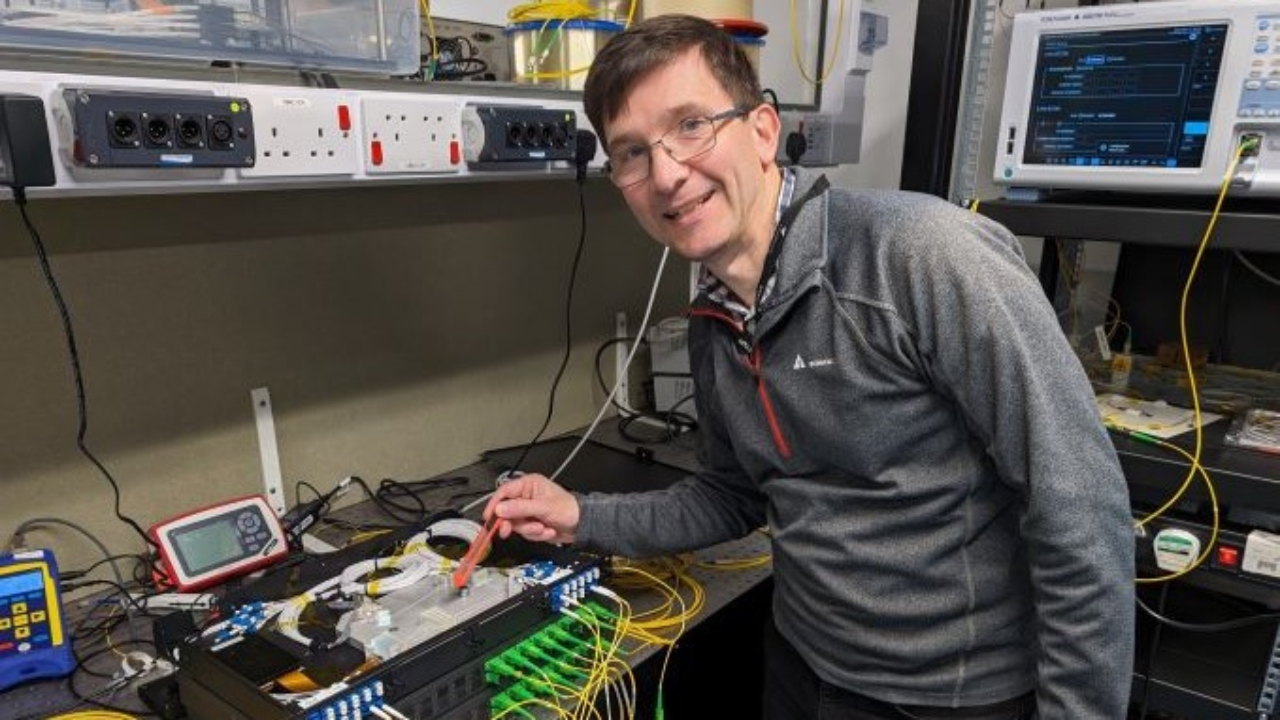
A team of researchers from Aston University in England has set a new record in internet speed. Using a standard optical fiber, scientists recorded a speed of 301 Tbps – that's 301,000,000 Mb/s.
By current standards, 301 Tb is equivalent to downloading about 9,000 high-definition images in one second. At this speed, you can download all the movies listed on the Internet Movie Database (IMDb) in a minute.
In the experiment, the researchers used a traditional fiber optic system capable of reaching specific bands with different wavelengths. This made internet speeds 4.5 million times faster than the average connection in the UK.
Ultra-high-speed data transfer is the result of collaborative research between two professors at Aston University: Wladek Forysiak from the Institute of Photonic Technologies and Ian Phillips from the School of Computer Science and Digital Technologies.
The researchers worked with scientists from the National Institute of Information and Communications Technology (NICT) in Japan, and Nokia Bell Labs in the US.
The science of recording internet speeds
To achieve record speeds, scientists are betting on the ability of optical fiber to transmit information through light, which travels through glass tubes almost as thin as strands of hair.
Because fiber optics uses light, it is necessary to open up new wavelength ranges. With this, the researchers were able to transmit other types of light through the cables.
To access the passive tracks, both used devices called optical amplifiers and optical gain equalizers. In Official announcementProfessor Ian Phillips explained:
“Broadly speaking, data is transmitted over optical fiber, like an Internet connection in a home or office. However, instead of the commercially available C and L bands, we use two additional spectral bands called E band and S band.
These bands are traditionally not necessary because C and L bands can provide the necessary capacity to meet the needs of consumers.
In recent years, Aston University has been developing optical amplifiers that operate in the E band, which is close to the C band in the electromagnetic spectrum, but three times wider.
Before developing our device, no one was able to accurately track E-band channels in a controlled manner.
Ian Phillips is Professor in the School of Computer Science and Digital Technology at Aston University
Professor Wladek Forysiak also commented that the idea of the trial was to improve the internet connectivity of users without increasing the cost of the technology.
“By increasing transmission capacity in the backbone network, our testing will lead to better connections for end users. This exciting achievement highlights the critical role of advancing fiber optic technology in revolutionizing communications networks for faster and more reliable data transmission.”
Increasing computing capacity by using available spectrum—not just the conventional C-band, but also other bands such as the L, S, and now E-bands—will help keep the cost of providing this spectrum low.
It is a 'greener solution' than using more fiber and new cables because it makes more use of the existing fiber network, increases data carrying capacity and extends both its useful life and business value.
Wladek Forysiak is a professor at the Institute of Photonic Technology at Aston University
The results of the experiment were published by the Institute of Engineering and Technology (IET). They were presented at the European Optical Communication Conference (EOCC) in Glasgow in October 2023.

Henry Blackwell is a contributor at Mediarunsearch.co.uk, covering a wide range of topics including news, politics, business, technology, sport, entertainment, and lifestyle. He focuses on delivering clear, balanced reporting and useful information that helps readers stay informed about current events and emerging developments. His work highlights stories that matter to everyday audiences, with an emphasis on accuracy, relevance, and accessible journalism.