
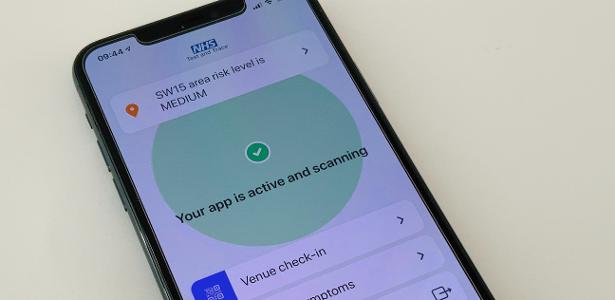
A new study suggests that the use of contact tracing systems has helped save thousands of lives in the UK. Nearly 9,000 people in England and Wales have been saved thanks to the NHS Covid-19 app, which uses an exposure notification system developed by Apple and Google, the survey published by Nature says. Brazil had a similar solution with the Coronavirus-SUS implementation, but it was not very successful due to the lack of an explanation and publication of the tool.
a Research It shows that the app for the NHS, the British public health system, may have saved between 4,200 to 8,700 lives – the UK has recorded more than 128,000 deaths from covid-19 so far. According to the study, every percentage point increase in app usage led to a decrease of 0.79% of cases.
The study adds: “Our analysis indicates that a large number of cases of COVID-19 infection have been prevented by contact tracing through the NHS app, ranging from around 100,000 to 900,000, depending on methodological details.”
The researchers assessed app usage between September and December 2020. In total, 16.5 million people installed the app (equivalent to 28% of the UK population), and 1.7 million exposure notices were sent.
Integration with tests
The study indicates that application integration with COVID-19 tests was important for controlling the spread of the disease. This is because “tests performed through the application launch procedures automatically, without requiring the user to enter the result in the application,” which speeds up contact tracing.
In addition, the study develops theories about how application functions contribute to its effectiveness. The survey indicates that those who installed the app tend to keep social distancing higher than they would have done if they didn’t have the app, because they would realize that it “monitors distance and can advise them to quarantine later”.
The study concludes, “Smartphone use is truly global, and therefore, contact tracing apps that maintain privacy should be integrated into the public health toolkit.”
In Brazil, the application failed due to lack of use
Not many people know, but in March 2020, the government released the Coronavirus-SUS app, which later became equipped with a contact tracing function. The process was similar to the NHS app, that is, it would be possible to know when a sick person near you came by using the Bluetooth feature of mobile phones.
However, this national implementation “failed” mainly because no one explained how the tool worked and there was no campaign explaining the app’s benefits.
Coronavirus-SUS started using Apple and Google technology in August last year. It was revealed mainly by the press and on the Ministry of Health’s YouTube channel, which recorded fewer than 10,000 views at the time.
The little revelations may have been reflected in the Brazilians’ minimal adhesion to the supplier. As of April of this year, Coronavirus-SUS had been downloaded 61.5 million times, according to Health Department data to Tilt. But there were only 2.3 million active users until February 2021, less than 1% of Brazil’s population.
However, Claudio Mesili, professor of systems and computer engineering at UFRJ (Federal University of Rio de Janeiro), does not attribute the failure of the Coronavirus-SUS only to lack of detection. He claims that contact tracing faces a technical problem that bother Brazilians: the smartphone battery.
He explained, “In general, the Brazilian does not usually leave bluetooth turned on, because it drains the battery. The application makes sense from a technological point of view, but in practice, it will probably not be enough for Brazil.”
Another point he raised is that every Brazilian has a smartphone and that the SUS app has limited compatibility – to use it, it is necessary to have an iPhone with at least iOS 13 or a mobile phone running Android 6.0 or higher.

Charlotte Whitmore is a contributor at Mediarunsearch.co.uk, covering a broad range of topics including news, politics, business, technology, sport, entertainment, and lifestyle. She focuses on delivering clear, balanced reporting and practical information that helps readers stay informed about current events and emerging developments. Her work highlights stories that matter to everyday audiences, with an emphasis on accuracy, relevance, and accessible journalism that keeps readers connected to the issues shaping the UK and beyond.