
- Jonathan Amos
- BBC science correspondent
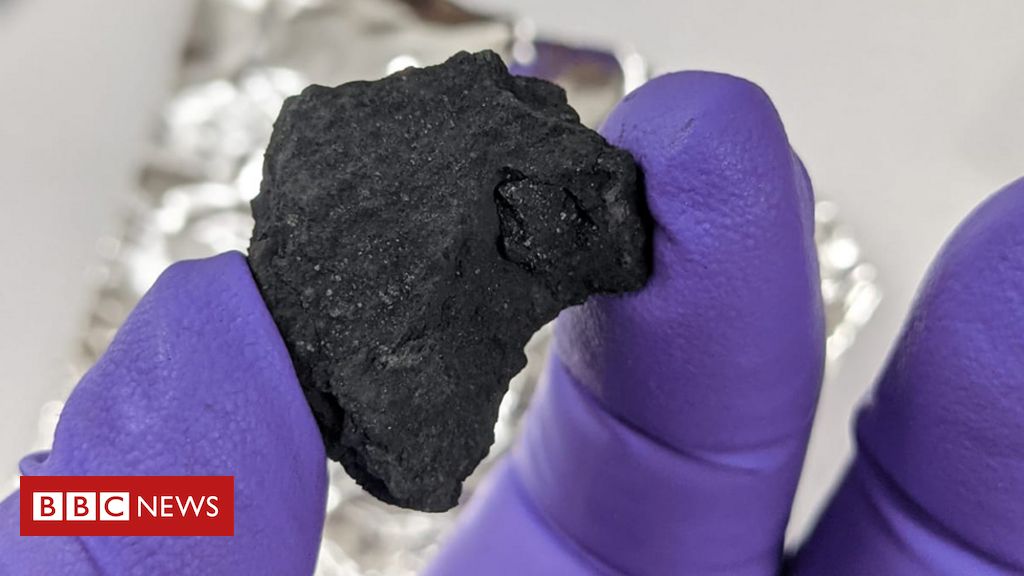
The Winchcombe meteorite broke off from an asteroid located between Mars and Jupiter
The meteorite that fell in the town of Winchcombe in south-east England last year contained water almost exactly identical to that found on Earth.
This reinforces the idea that rocks from space may have brought important chemical components, including water, to our planet early in its history, billions of years ago.
This meteorite is considered the most important meteorite ever found in the United Kingdom.
Scientists, who have just published the first detailed analysis, say the body has provided fascinating information.
More than 500 grams of dark debris was collected from residential gardens, sidewalks and fields after a giant fireball lit up the night sky over Winchcombe.
The fragmentary remains were carefully cataloged at the Natural History Museum in London, then loaned to teams across Europe for investigation.
Water represents up to 11% of the meteorite’s weight, and contains a very similar ratio of hydrogen atoms to water on Earth.
Some scientists say that when the Earth was young, it was so hot that it expelled much of its volatile contents, including water.
The fact that Earth contains so much water today—70% of its surface is covered by oceans—suggests that there must have been a later addition.
Some claim this could come from bombardment by icy comets, but their chemical compositions don’t closely match.
But carbonaceous chondrites – meteorites like Winchcombe – certainly match.
The fact that it was recovered less than 12 hours after the fall means that it absorbed very little ground water, or even any contaminants.
“All other meteorites have been compromised in one way or another by Earth’s environment,” lead author of the study Ashley King, from the Natural History Museum in London, told BBC News.
“But the one at Winchcombe is different because of how quickly it was collected.”
He added: “This means that when we analyze (the meteorite), we know that the composition we see takes us back to the composition at the beginning of the solar system, 4.6 billion years ago.”
“Aside from bringing back rock samples from an asteroid with a spacecraft, we can’t get a more primitive sample.”
Accurate path
Scientists who examined the meteorite’s carbon- and nitrogen-containing organic compounds, including amino acids, had an equally clear picture.
It is chemistry that could have been the raw material for starting biology in the early days of the Earth.
The new analysis also confirms the meteorite’s origin.
Video footage of the fireball allowed researchers to chart a very precise path.
Backward calculations indicate that the meteorite came from the outer part of the asteroid belt between Mars and Jupiter.
A fragment of the Winchcombe meteorite was recently sold at auction for more than 120 times its weight in gold.
Further investigation reveals that it broke off from the top of a larger asteroid, possibly due to impact.
It then took only 200,000 to 300,000 years to reach Earth, as evidenced by the number of specific atoms, such as neon, that were formed in the meteorite material by continuous irradiation of high-speed space particles, or cosmic rays.
“0.2 to 0.3 million years seems like a long time, but from a geological point of view, it’s actually very fast,” explains Helena Bates of the Natural History Museum in London.
“Carboniferous chondrites have to get here quickly or they won’t survive, because they’re too brittle, too brittle, and they break down.”
“More secrets”
The scientists’ first analysis, published in this week’s issue of the journal Science Advances, is just an overview of the properties of the Winchcombe meteorite.
Dozens more articles on more specific topics are scheduled to be published soon in an issue of Meteoritics & Planetary Science.
The matter should not stop there.
“Researchers will continue to study this sample in the coming years, revealing more secrets about the origins of our solar system,” said study co-author Luke Daly of the University of Glasgow in Scotland.

Charlotte Whitmore is a contributor at Mediarunsearch.co.uk, covering a broad range of topics including news, politics, business, technology, sport, entertainment, and lifestyle. She focuses on delivering clear, balanced reporting and practical information that helps readers stay informed about current events and emerging developments. Her work highlights stories that matter to everyday audiences, with an emphasis on accuracy, relevance, and accessible journalism that keeps readers connected to the issues shaping the UK and beyond.