
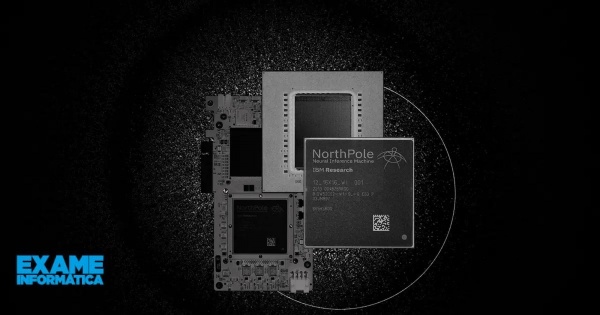
“Its energy efficiency is a breakthrough on a massive scale,” says Damien Kerlioz, a researcher at the University of Paris-Saclay, quoted by the website. SciencesLearn about IBM’s new NorthPole chip in detail. In this technology, scientists have created a processor that eliminates frequent access to external memory and is thus able to perform image recognition tasks much faster than current architectures and consumes less power in the process.
These chips are based on neural networks, with multiple layers of simple computational units programmed to recognize patterns. Some chips already developed perform the same type of computation, but to do so, they need to use external memory, RAM, each time they compute a layer, which ultimately compromises potential performance and requires more power. Co-author of this work from IBM, Dharmendra Modha, estimates that simulating a human brain with the usual architecture would require the energy equivalent of 12 nuclear reactors.
NorthPole consists of 256 computing modules, each with its own memory, which mitigates the effect described previously. Each of these units, or nuclei, works together, with network logic, in a way inspired by the shape of white matter in the human brain.
The authors estimate that if NorthPole were implemented using state-of-the-art manufacturing processes, its efficiency would be 25 times better than conventional processors. The challenge facing the team now involves studying the applications of these chips in current scenarios, such as self-driving cars, for example.

Edward Langley is a contributor at Mediarunsearch.co.uk, covering a wide range of topics including news, politics, business, technology, sport, entertainment and lifestyle. He focuses on delivering clear, balanced reporting and useful information that helps readers stay informed about current affairs and developing stories. His work highlights issues, trends and events that matter to everyday audiences, with an emphasis on accuracy, relevance and accessible journalism.