
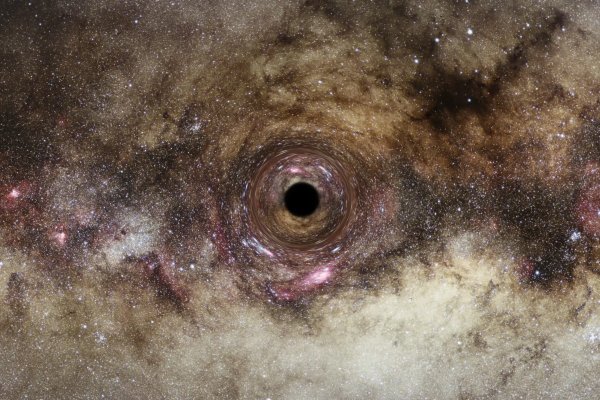
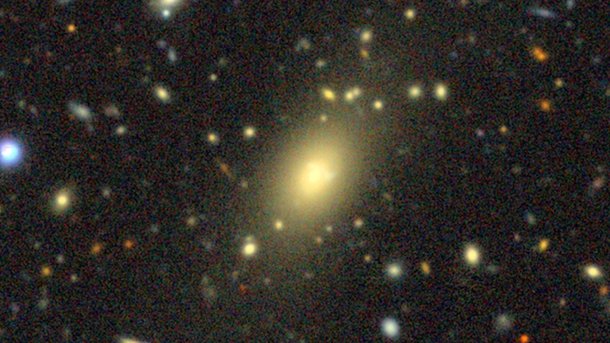
Astronomers from the Department of Physics at Durham University, UK, have identified a black hole of astonishing proportions in the galaxy cluster Abell 1201. Located 2.7 billion light-years from Earth, the cosmic formation occupies the brightest group of stars in the region and features about 30 billion times the mass of the Sun. Only through the space-time trick predicted by Albert Einstein.
Considered a “supermassive beast”, the black hole is one of the largest ever discovered and draws attention since it is about eight thousand times more massive than the supermassive black hole at the center of the Milky Way. In doing so, it will be second only to the quasar TON 618, which contains approximately 66 billion solar masses and is 10.4 billion light-years away from Earth.
The measurement was made possible by the techniques of the DiRAC COSMA8 supercomputer, which collected high-resolution images provided by the Hubble Space Telescope and collaborated with simulated tests, in which the massive object’s mass was estimated with the aim of bending light at scale. provided by the equipment. “It represents the theoretical upper limit of how large black holes can go,” said James Nightingale, project leader. “Finding supermassive black holes is just the first step in figuring out how these monsters grow so massive.”
 (Source: Wikipedia / Reproduce)
For this, astronomers relied on knowledge formulated by physicist Albert Einstein, a pioneer in space-time studies and the father of the iconic theory of relativity. According to him, large-scale objects in the foreground can distort the fabric of the universe through the movement of energy and matter. Thus, it would be possible to produce a force that is not visible, but is derived from the bending and distortion of bright light: gravity.
Gravitational lens as a real lens
Through the idea of revealing celestial bodies that are faint and relatively invisible in other ways, gravitational lensing has become a way to break down the barriers imposed by the limits of space observation. In the case of Abell 1201, the theory showed a kind of duplicate of the brightest galaxy in the cluster and allowed the identification of a black hole of, until then, unknown size.
“This particular black hole, which has a mass of about 30 billion times the mass of our Sun, is one of the largest ever discovered and is at the maximum size that we think black holes can theoretically become, so it is a very exciting discovery,” Nightingale said. .
According to the astronomer, gravitational lensing, linked to concepts in Einstein’s theory of general relativity, is even capable of recording inactive black holes. Therefore, understanding the phenomenon and improving it through modern telescope techniques can reveal how these objects have evolved in cosmic time.
It should be noted that this is not the first time that gravitational lensing has supported the identification of exoplanets and black holes. This year, a signal, located 8 billion light-years from Earth, was described as possibly revealing the secrets of the universe. Meanwhile, a project from the first half of 2010 highlighted a sudden collision between two distant galaxies.

Charlotte Whitmore is a contributor at Mediarunsearch.co.uk, covering a broad range of topics including news, politics, business, technology, sport, entertainment, and lifestyle. She focuses on delivering clear, balanced reporting and practical information that helps readers stay informed about current events and emerging developments. Her work highlights stories that matter to everyday audiences, with an emphasis on accuracy, relevance, and accessible journalism that keeps readers connected to the issues shaping the UK and beyond.