
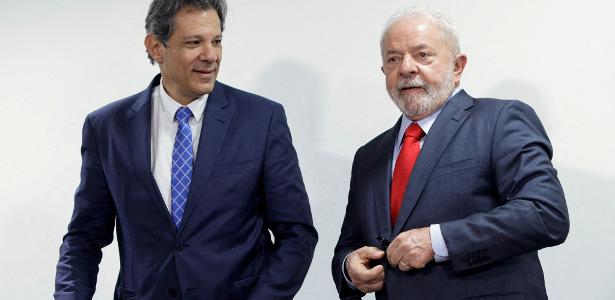
After all the calculations, the first impression of many was confirmed: to comply with the rules for controlling public accounts announced by Finance Minister Fernando Haddad, an increase in revenue would be required. In other words, the tax burden, which in the aggregate is already quite high, may increase.
For many, this is an unimaginable path that would doom the economy to stagnation. Others, however, recognize that there is scope for expanding tax collection, which allows for expansion of public spending without squeezing public debt, which helps boost economic activity.
The frame depends on the recipes
From Michel Temer’s government, and later in Bolsonaro’s government, curbing public spending was the way to try to control public accounts. did not work. Not only has the economy failed to escape low growth, but the financial situation has become even more precarious.
In the election campaign, Lula insisted in his speech that if he is elected on the issue of public accounts, he will try to expand spending, but with fiscal responsibility. This strategy means the pursuit of increased revenue. Therefore, there should be no surprise from the path chosen and confirmed now.
In designing the “fiscal framework” by which it would at least seek to stabilize total public debt in relation to GDP (Gross Domestic Product), Haddad had to balance spending control with Lula’s promises to increase expenditures “to bring the poor into the budget”. “.
To close this equation, the avenue found by the minister would have already been granted by Lula himself in the election campaign. It is about “including the rich in income tax”, or, in other words, increasing the collection, and therefore the tax burden, with an emphasis on those who do not pay taxes or pay little.
Where can more taxes be levied?
It is uncertain whether, after four years, the proposed anchor will be able to stabilize the debt and, before that, increase spending, where Lula’s government. But there is room to achieve this goal.
Although the overall size is high, the tax burden, like the income and opportunity in this country, is very unevenly distributed.. In Brazil’s dysfunctional tax system, low-income people end up paying more in taxes than high-income earners.
If an employee on a formal contract pays 27.5% of the income tax, another taxpayer performs the same function, but under the well-known service provider – PJ system – collects just over 16% of the wage and not 10%, if enrolled in the Simples Nacional scheme.
Not to mention the income generated from company profits and dividends received by individuals that are completely exempt from direct taxes.
It is possible to list more than a dozen cases in which revenue losses do not lead to economic or social gains that justify them. See examples:
Sports betting
Exclusive investment funds
Senior technicians
Online imports
interest on shares
More than high, the load is poorly distributed
In addition to enduring blatant financial injustice, this deeply reactionary system is economically inefficient. By taxing those with lower incomes, the taxes should be heavier so that a volume of revenue is obtained capable of satisfying the minimum broad social needs of a country with extreme poverty and strong concentration of income.
The total tax burden equates to just over 33% of the GDP, which is high compared to other emerging countries. It is closer to countries with mature economies in Europe, but its composition shows that it needs a better distribution:
Taxation of consumption of goods and services. The Brazilian burden, with 15% of GDP, is the third highest in the group of 34 countries between developed and emerging countries.
Taxation of income, profits and capital gains. The Brazilian burden, at about 7% of GDP, is the fifth lowest in this group of 34 countries.
Property Taxes. The Brazilian load is close to the average of 34 countries, with 1.5% of GDP, but much lower than countries like the United States, the United Kingdom, France and even Korea, which charge property taxes at least twice as much as Brazil.
To correct distortions and eliminate or reduce exemptions, Haddad envisions an increase of between R$100 billion and R$150 billion, which is roughly 1.5% of GDP, in revenues in 2024. It is not, in theory, a far-fetched goal.
Just “tax expenditures” — a combination of exemptions and cuts in special system taxes, which, in practice, means lost revenue — add up to R$450 billion in 2023, an amount equivalent to 4% of GDP. The problem is how to undo the benefits to powerful business sectors and interest groups, well represented in Congress.

Charlotte Whitmore is a contributor at Mediarunsearch.co.uk, covering a broad range of topics including news, politics, business, technology, sport, entertainment, and lifestyle. She focuses on delivering clear, balanced reporting and practical information that helps readers stay informed about current events and emerging developments. Her work highlights stories that matter to everyday audiences, with an emphasis on accuracy, relevance, and accessible journalism that keeps readers connected to the issues shaping the UK and beyond.