
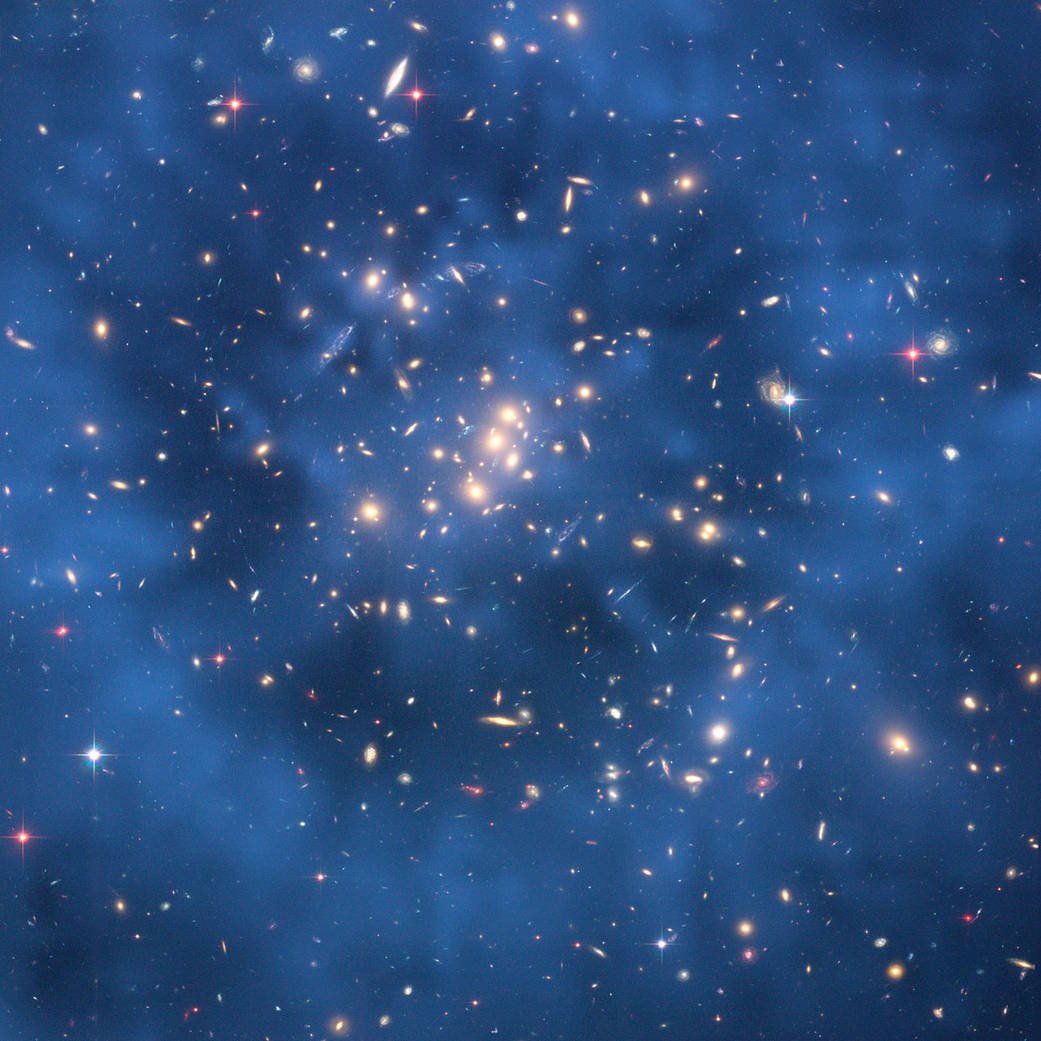
the dark matter It could consist of very light dark photons that have heated our universe. This is the new scenario proposed in the study published recently in the magazine Physical review letters. This hypothesis, the authors say, is consistent with observations made by the Cosmic Origin Spectrometer (COS) aboard the Hubble Space Telescope, which is making measurements of the “cosmic web,” the intricate and tenuous network of filaments that fill the space between galaxies.
The data collected by COS indicate that the intergalactic cosmic filaments are much hotter than predicted from hydrodynamic simulations of the Standard Model of structure formation.
“Since dark photons will be able to transform into low-frequency photons and heat cosmic structures,” the scientists explained, “they can explain the experimental information well.” The study was conducted by researchers from the International School for Advanced Studies (SISSA, Italy) in collaboration with researchers from the Universities of Tel Aviv (Israel), Nottingham (UK) and New York (USA).

good candidates
“Dark photons are a new hypothetical particle that is the force carrier of a new force in the dark sector, just as a photon is the force carrier of electromagnetism,” explained study authors James S Bolton (University of Nottingham), Andrea Caputo (CERN). and Tel Aviv University, France), Hongwan Liu (NYU), and Mathieu Fell (SISSA).
“Unlike a photon, they can have mass. In particular, the very light dark photon—which has a mass 20 times less than that of an electron—is a good candidate for dark matter.”
Dark photons and ordinary photons such as different types of neutrinos are also expected to mix, allowing dark matter to convert very dark photons into lower-frequency photons. These photons will heat up the cosmic web, but unlike other heating mechanisms based on astrophysical processes, such as star formation and galactic winds, this heating process is also more widespread and effective in low-density regions.
missing element
Mathieu Viel explained: “Usually cosmic filaments are used to probe the properties of dark matter on a small scale, while in this case we used for the first time data from the low redshift intergalactic medium as a calorimeter, to see if all the heating processes that we know are sufficient to recreate Data production. We found that this is not the case: something is missing, which we modeled as a contribution produced by the dark photon.”
The work determined the mass and combination of the dark photon with the standard photon required to reconcile the discrepancy between the observations and simulations. This effort could lead to further theoretical and observational investigations exploring the exciting possibility that dark photons could form dark matter.
see also

Charlotte Whitmore is a contributor at Mediarunsearch.co.uk, covering a broad range of topics including news, politics, business, technology, sport, entertainment, and lifestyle. She focuses on delivering clear, balanced reporting and practical information that helps readers stay informed about current events and emerging developments. Her work highlights stories that matter to everyday audiences, with an emphasis on accuracy, relevance, and accessible journalism that keeps readers connected to the issues shaping the UK and beyond.