

Published on 06/29/2022 06:00
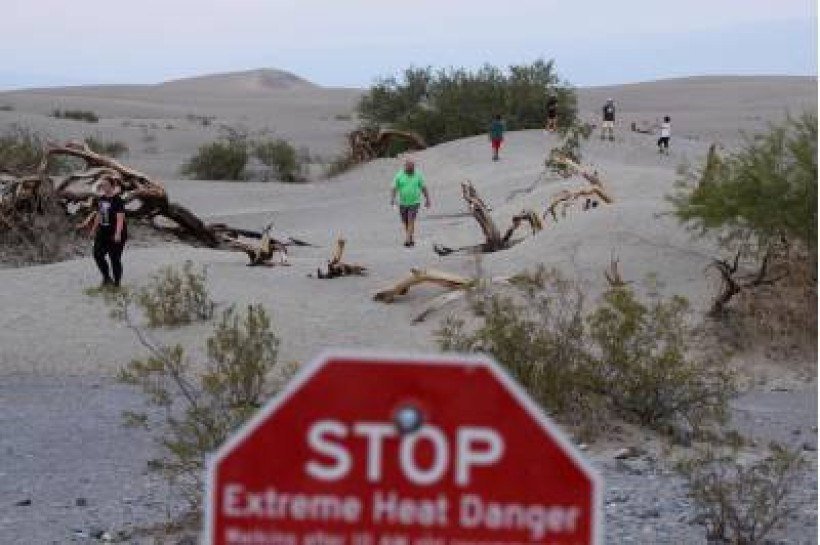
Severe heat sign in California park, USA: Countries have set record temperatures in recent years – (credit: PATRICK T. FALLON)
Extreme temperatures, droughts, floods and disease outbreaks are increasingly visible effects of global warming. Researchers at the University of East Anglia, UK, have outlined how containment measures can protect the planet and people. Through sophisticated computer simulations, they concluded that limiting global warming to 1.5°C, as envisaged in the Paris Agreement, would reduce risks to humans by up to 85%.
The team used temperature increases of 2°C and 3.66°C as a comparison. Given the first scenario, 1.5°C and 2°C, globally, the risk is reduced between 10% and 44%. In the 1.5°C and 3.6°C scenario, between 32% and 85%. The ranges of risk variance are wide because the percentage depends on the indicator being considered.
Five factors were assessed: changes in vulnerability to water scarcity and heat stress, vector-borne diseases, coastal and river flooding, and projected impacts on agriculture and the economy. According to the authors, in percentage terms, risk aversion is higher for river flooding, drought and heat stress. In absolute numbers, for drought. Details of the work were published in the latest issue of Climatic Change.
The authors also tracked the potential impacts of the major threats. In the case of coastal flooding, global warming of 1.5°C would put 41 to 88 million people annually at risk, associated with sea level rise of 0.24 to 0.56 metres. The number will rise to 41 to 95 million threatened if the temperature increases by two degrees Celsius, which will lead to a sea rise between 0.27 and 0.64 meters.
In the case of drought, projections suggest a scenario of “hundreds of millions of people affected additionally… at each successive level of warming.” When it comes to diseases transmitted from animals to humans, zoonoses in general, the exposure of the world’s population to malaria and dengue would be 10% lower if warming were limited to 1.5°C instead of 2°C, the study suggests.
The paper’s lead author, Rachel Warren, said in a statement that the findings are important because the goal of the Paris Agreement is to limit global warming to “well below” 2 degrees Celsius. “This means that decision makers need to understand the benefits of targeting lower value,” he asserts.
The world also remembers that, at COP26, last year, in Glasgow, the commitments made by countries in terms of reducing greenhouse gas emissions were not enough to achieve the Paris targets. “Currently, current policies will lead to an average temperature increase of 2.7°C, while the Nationally Determined Contributions (the targets set by each country to contain climate change) for 2030 will limit warming to 2.1°C,” he says.
According to Warren, there are a series of additional measures planned to reduce emissions, with the potential, in the most optimistic case, to limit warming to 1.8 degrees, which could produce effects even greater than those expected in the group’s best-case scenario.
local analytics
The British team also identified areas considered most vulnerable to climate change. West Africa, India and North America are the regions where the risks of global warming are expected to increase more than 1.5°C or 2°C by 2100.
In contrast, the population’s vulnerability to water scarcity is expected to be more pronounced in western India and northwestern Africa. South America is referred to as a region where the number of people exposed to drought conditions is likely to increase, as is the case in Europe and East Asia.
Effects on farm incomes and the economy were also part of the analysis. According to the British team, the global economic impacts of climate change are reduced by 20% when warming is limited to 1.5°C instead of 2°C. Net damages were correspondingly reduced from $61 trillion to $39 trillion.

Charlotte Whitmore is a contributor at Mediarunsearch.co.uk, covering a broad range of topics including news, politics, business, technology, sport, entertainment, and lifestyle. She focuses on delivering clear, balanced reporting and practical information that helps readers stay informed about current events and emerging developments. Her work highlights stories that matter to everyday audiences, with an emphasis on accuracy, relevance, and accessible journalism that keeps readers connected to the issues shaping the UK and beyond.