
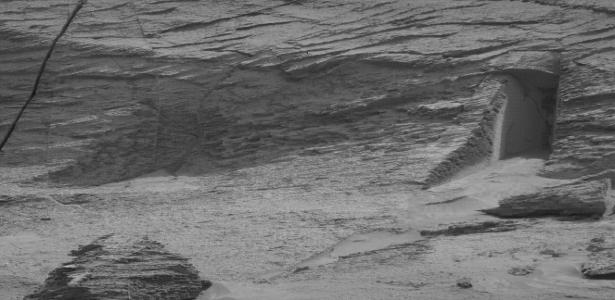
An image recorded by NASA’s Curiosity rover on Mars showed an unusual formation that piqued the curiosity of Reddit users.
A topic on the social network wondered if this would be a “door” that would prove the existence of extraterrestrial life on the neighboring planet. The similarity sparked discussions on the net, but the possibility was quickly dismissed.
In a conversation with Britain’s The Daily Telegraph, Professor Sanjeev Gupta, a professor at Imperial College London who worked with the mission that took Curiosity to Mars, explained that the “door” shown in the image is nothing more than a geological process.
“This fracture is a fracture. Such fractures are abundant on Mars and Earth,” he explained. He analyzed the photo at the newspaper’s request and asserted that this was just a “natural geological process” in the area.
The expert also said that perspective should be considered in this case, and Curiosity researchers highlighted the size of the “door” when releasing the image.
“They highlighted how small the fractures are between 30 and 45 centimeters,” he said.
Curiosity trip
The space robot landed in Gale Crater in August 2012 on a mission to determine if the area harbored microbial life.
Since then, it has traveled more than 27.14 km on the surface of Mars. Curiosity discovered that Gale did indeed host a habitable lake and stream system in the distant past.
Since September 2014, Curiosity has been climbing a mountain called Mount Sharp. In practice, the rover is analyzing rock layers, looking for clues about the climate shift that took place on Mars from a hot, humid planet to the frigid desert it is today.
“It seems the study worked,” Judd said. The mission team recently began taking wheel-check images every 3,300 feet, or 1,000 metres, of cut terrain, instead of every 1,600 feet (500 metres) as was previously the case.

Edward Langley is a contributor at Mediarunsearch.co.uk, covering a wide range of topics including news, politics, business, technology, sport, entertainment and lifestyle. He focuses on delivering clear, balanced reporting and useful information that helps readers stay informed about current affairs and developing stories. His work highlights issues, trends and events that matter to everyday audiences, with an emphasis on accuracy, relevance and accessible journalism.