
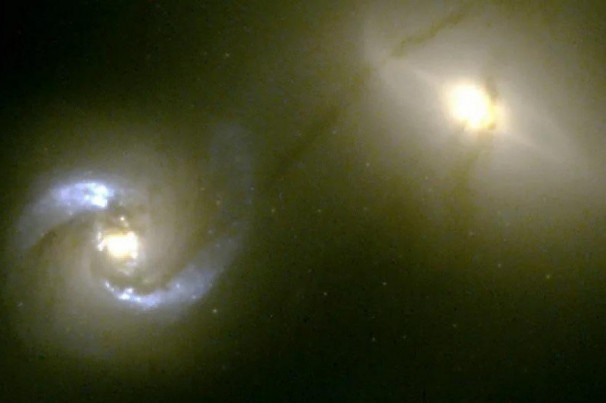
An international team of astronomers from the University of Nottingham in the UK, and the Center for Astrobiology (CAB, CSIC-INTA) in Spain used data from the Hubble Space Telescope and Gran Telescope to identify and study some of the world’s smallest galaxies. Close to Universe. EurekAlert portal.
The research revealed that the galaxies are likely to be irregular. The first results were recently published in the Monthly Notices of the Royal Astronomical Society.
One of the most intriguing questions astronomers have been trying to solve for decades is how and when the first galaxies formed. As for the question of how, one possibility is that the formation of the first stars within galaxies began at a steady pace, and little by little formed an increasingly massive system. Another possibility is that the formation was more violent and discontinuous, with intense, but short-lived, star formation explosions caused by events such as mergers and accretion of gases.
“The formation of galaxies can be compared to a car. The first galaxies probably had a ‘diesel’ star formation engine, slowly but constantly adding new stars, without significant acceleration and moderately converting gas into relatively small stars for long periods,” said Pablo J. Perez-Gonzalez, one of the co-authors. In the study affiliated with the Centro de Astrobiologia.
“Or the formation could be erratic, with bursts of star formation producing incredibly large stars that disrupt the galaxy and cause it to inactivate for some time or even forever. Each scenario is associated with different processes, such as star mergers or the impact of supermassive black holes. , and it has an impact on when and how carbon or oxygen is formed, which is essential for our life,” explained the researcher.
Using the gravitational lensing power of some of the universe’s most massive galaxy clusters with extraordinary data from Gran Telescopio Canarias from the SHARDS Project, astronomers have searched for close analogues of the universe’s first formed galaxies so they can be studied in more detail.
Researchers have combined the power of more advanced telescopes, such as Hubble and the Canary Islands, with the help of “natural telescopes”.
“Some galaxies live in large groups, what we call clusters, which contain large amounts of mass in the form of stars, but also gas and dark matter. Their mass is so great that they bend spacetime and behave like natural telescopes. We call them gravitational lenses and allow us to see distant, blurry galaxies with greater luminosity and greater spatial resolution.
“We were able to find these objects due to high-quality data from the SHARDS project combined with Hubble image data to detect hot gas heated by newly forming stars in very small galaxies. This hot gas is emitted at certain wavelengths, what we call emission lines, such as neon light. Analysis of these emission lines can provide insight into galaxy formation and evolution.” (with Sputnik Brazil)

Charlotte Whitmore is a contributor at Mediarunsearch.co.uk, covering a broad range of topics including news, politics, business, technology, sport, entertainment, and lifestyle. She focuses on delivering clear, balanced reporting and practical information that helps readers stay informed about current events and emerging developments. Her work highlights stories that matter to everyday audiences, with an emphasis on accuracy, relevance, and accessible journalism that keeps readers connected to the issues shaping the UK and beyond.