
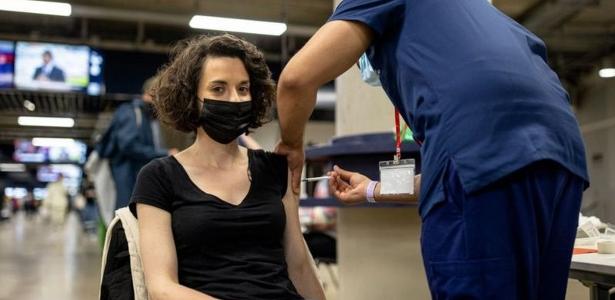
Experts say declines are to be expected and booster doses may be needed, at least for some people.
Researchers say they see a decrease in protection from Covid-19 infection in people who have received two doses of the vaccine.
One study, conducted in the United Kingdom with real-world data, looked at positive PCR results between May and July 2021 in more than 1 million people who received two doses of either Pfizer or AstraZeneca.
Protection after two doses of Pfizer decreased from 88% in one month to 74% in five to six months. In the case of AstraZeneca, the drop fell from 77% to 67% in four to five months.
According to experts, a decrease in protection is expected.
Although there have been cases of infection in fully vaccinated individuals, vaccines still do a good job of protecting the population from the severe form of disease and deaths caused by Covid-19.
Vaccines save lives
Public Health England, the British government’s public health agency, estimates that around 84,600 deaths and 23 million infections have been averted as a result of the Covid-19 vaccination campaign in England so far.
Professor Tim Spector of King’s College London (KCL), who led the study based on data from the epidemiological research app Zoe Covid, says the findings could explain recent infections reported by some fully vaccinated people.
“The decrease in protection is to be expected and not a reason not to vaccinate,” he says.
“Vaccines still provide high levels of protection for the majority of the population, particularly against the delta variant, so we still need as many people as possible for full immunization.”
Is it estimated that protection against infection could drop to 50% in winter and would booster doses be needed? But other experts urge caution when making forecasts for the coming months.
The UK is expected to start providing a third dose of the Covid vaccine to some people next month, but the government is awaiting recommendations from an independent advisory body called the JCVI, which is looking at evidence to support the decision.
“A lot of people may not need it,” Spector says. “A lot of people may have had a natural booster because they already had a natural covid infection, so they would have had three vaccinations.”
“So I think the whole thing has to be managed more carefully than just giving (the third dose) to anyone else, which would be a huge waste and ethically questionable given the resources we have. I think we need one. A more targeted approach than last time” .
Levels of infection in a community will alter the chance of a person (with the virus) coming across and contracting the virus at any time, says Simon Clark, an expert in cellular microbiology at the University of Reading, UK, making it difficult to draw definitive conclusions about immune decline.
Alexander Edwards, also of the University of Reading, says it’s important to understand when and for whom booster doses might be needed.
“Vaccination does not put people at risk – nor does it prevent all infections. Strains have a real and significant impact on public health, and tragically many people continue to die in the UK from this horrific virus.”
“The vaccines we have are remarkably safe and effective, and are still much better than other vaccines that offer tremendous benefits.”
“We must proactively plan our public health strategy to take into account imperfect protection and the potential for protection to decline over time,” he adds.
A similar study was published by the Office for National Statistics and the Oxford Vaccine Group last week.
Based on the results of PCR testing of nearly 400,000 people with the delta variant in the UK, it showed that two doses of Pfizer’s vaccine were initially 90% more effective against symptomatic Covid infection, compared to about 70% in the case of coronavirus. AstraZeneca vaccine.
But over the course of three months, Pfizer’s protection decreased significantly, while AstraZeneca’s immunity remained more stable.
Professor Adam Fane, a government advisor on vaccines, said other studies had shown that vaccines maintain good protection against serious illness and hospitalization.
But he added, “We need to be very careful to see if this reduction (in immunization) for mild disease starts to turn into more severe cases, because then booster doses will be needed.”
At the moment, there is still no definition for a booster vaccine in Brazil, but both the Ministry of Health and the Butantan Institute (which are responsible for finalizing CoronaVac production in the country) acknowledge that they are evaluating and considering this possibility.

Charlotte Whitmore is a contributor at Mediarunsearch.co.uk, covering a broad range of topics including news, politics, business, technology, sport, entertainment, and lifestyle. She focuses on delivering clear, balanced reporting and practical information that helps readers stay informed about current events and emerging developments. Her work highlights stories that matter to everyday audiences, with an emphasis on accuracy, relevance, and accessible journalism that keeps readers connected to the issues shaping the UK and beyond.