
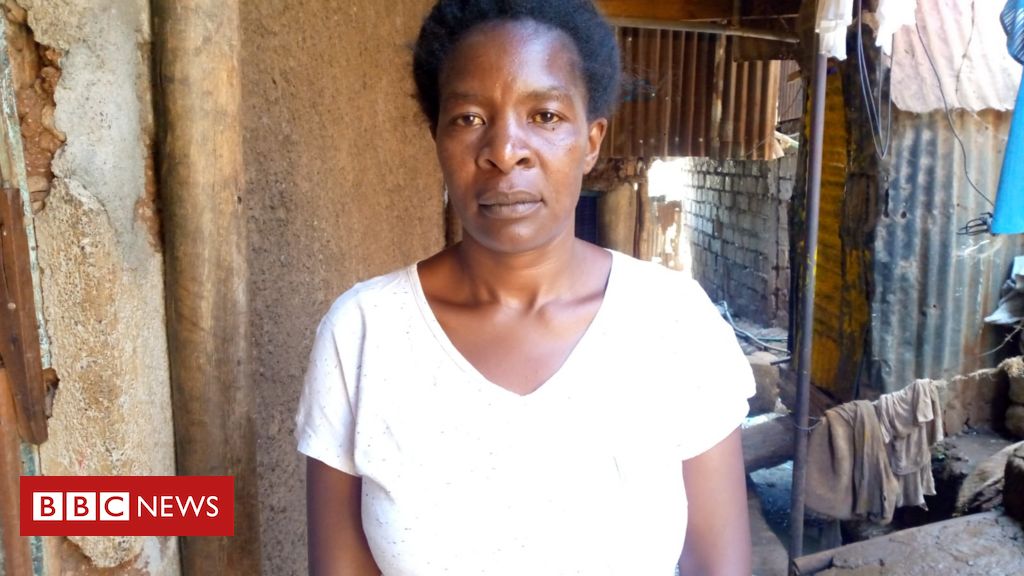
Evarlene Okello, a Kenyan mother of four, got into debt to give money to a pastor
Evarlene Okello breaks down in tears as she says she fell into debt after paying a priest to pray for her.
She lives in a small shack in Kibera, a vast slum in Nairobi, the capital of Kenya, and can no longer support her four children.
Evarline hasn’t earned anything in months, she told him on the phone. So when he heard about a pastor whose prayers could make life better, he wanted to meet him. He asked her for 15,000 Kenyan shillings (about R$600).
This practice is known as a “seed offering”: a financial contribution to a religious leader, with a specific goal in mind.
Evarline borrowed money from a friend who borrowed in her name. She was told that this pastor’s prayers were so powerful that she would see her money back within a week.
But the miracle never came. In fact, things got worse, she says.
The amount to be repaid for the friend’s loan exploded because of the interest. She now owes the equivalent of more than R$1,500 and has no idea how to pay it back. The friend has stopped talking to her and Evarline is still out of a job.
“Things got so difficult that I lost all hope,” she says.
“Supernatural Solutions”
Kenya – a country located east of the African continent, at the height of the equator, bordered by Ethiopia, Somalia, Uganda and Tanzania – has been hit hard by the global inflation crisis.
There, food prices rose about 16% in the 12 months to September 2022, according to Kenya’s National Bureau of Statistics, while World Bank data shows the number of unemployed Kenyans has doubled in the past seven years.
“People lead very miserable lives,” says Gladys Nyachew, a professor of sociology at the Multimedia University of Kenya.
Protesting the high cost of living in Kenya
This has increased the craving for supernatural solutions, she says, and many are now willing to pay for a miracle, even if they have to borrow money.
She says, “People are told that God does not want them to remain poor. So, they sow a seed.”
This practice is common in the so-called prosperity gospel, which preaches that God rewards faith with wealth and health. Believers are encouraged to show their faith by donating money to churches. And the belief that the donation will be rewarded by God with blessings even greater than the amount donated.
The prosperity gospel originated in the United States, gained traction in the early 20th century and spread to many countries, including Brazil.
In the late 1970s and early 1980s, Nigerian pastors came to the United States to learn more about this evangelical branch.
In the early 2000s, it spread across Africa and gained popularity, fueled in part by American missionaries such as Reinhard Bonck, who drew huge crowds from Lagos, Nigeria, to Nairobi, Kenya. This growth in the number of believers continues to this day.
German-American missionary Reinhard Bonke, who died in 2019, was very popular in Nigeria
The sociologist also points to another factor supporting indebtedness: the loan offers that Kenyans regularly receive on their mobile phones.
“People just sign up and get paid,” she says.
This is what happened to 26-year-old Dennis Obele. Frustrated after more than three years of looking for work, he turned to a friend for help.
“Tell me there’s a church you go to and they pray for you. You make a certain show, they pray for you, and then you can get a job,” says Dennis.
He was instructed to donate every Sunday for three months and donated the equivalent of a total of R$940.
When his savings ran out, he borrowed about R$600 from credit applications and friends.
“I believed what the priest told me, that I could get a job. So I had no problems getting loans because I thought I would eventually be able to pay the money back.”
But when no jobs could be found, Dennis began to suspect he had been scammed.
Dennis took apps loans to pay the chaplain
Soon he was pursued by credit companies. “Sometimes I sit somewhere, relax, think about other things. Then someone calls you, they want you to pay for it and you have nothing to pay,” he says.
“I was afraid because you don’t know what they can do if you don’t pay. You don’t know if you can be sued or taken to the police.”
Fortunately, Dennis was now able to find work, which allowed him to pay some money back to both the loan companies and his friends.
“I’m still a big believer in God,” he says. “All I have to do is be more careful.”
pressure to donate
It is not just Kenya where people are drowning in debt hoping for a miracle. A Nigerian church-going woman in the US said she and her husband were subjected to severe financial pressure – including the duty of “seeding”.
She asked that her name and the southern US state in which she lives be withheld, for fear of intimidating the church or its legal representatives.
Sarah (not her real name) says that both believers and local pastors at her former church had to give “tithes” equal to 10% of their monthly income to fund the church and its leaders in Nigeria.
And this is in addition to the so-called “first fruits” – a donation equal to all the income they received in the first month of the year.
American evangelist Oral Roberts (1918-2009), considered the “father” of the prosperity gospel
She says local leaders set monthly goals. Members were told that they would be blessed by the lead pastor in Nigeria.
Sarah says she’s seen people make donations with their credit cards at church services.
“I remember once in church a lady said, ‘I’ve paid the tithes and I still have enough money at the end of the month.'”
The pastor’s response, Sarah says, was to tell people that giving is more important than paying rent.
She says that anyone questioning why miracles don’t happen has been told, “You didn’t pray enough, you didn’t plant enough. You didn’t have enough faith.”
Sarah mentioned that her husband was pressured to leave because she kept asking questions – but they ended up leaving the church instead.
The last hope
It’s understandable why people keep giving even when “promises don’t pay off,” says Jörg Hausten, assistant professor of global Christianity at the University of Cambridge, UK.
For the middle and rising classes, like most people at Sarah’s Church, Hausten says the prosperity gospel offers “an atmosphere of economic success and upward movement that appeals to people.”
But he says that speech can also appeal to those in poverty.
“A church that says, ‘We know you’re hurting and we have a practical, achievable solution for you’ is going to be more attractive than a church that preaches some intangible systemic change.”
But why do people keep giving even when it means going into debt?
“Isn’t it like playing the lottery when you don’t have any money?” Hausten asks.
“It seems affordable because you can borrow a few hundred Kenyan shillings over the phone to invest and see if it helps,” he says.
“Of course, there is an element of despair as well, it might be anyone’s last hope.”
Back in Kenya, Evarlene says the experience didn’t make her give up her faith.
“I wouldn’t say the church is bad. The church is good. It’s the priests who do the wrong thing. They’re the ones asking for money.”

Charlotte Whitmore is a contributor at Mediarunsearch.co.uk, covering a broad range of topics including news, politics, business, technology, sport, entertainment, and lifestyle. She focuses on delivering clear, balanced reporting and practical information that helps readers stay informed about current events and emerging developments. Her work highlights stories that matter to everyday audiences, with an emphasis on accuracy, relevance, and accessible journalism that keeps readers connected to the issues shaping the UK and beyond.