
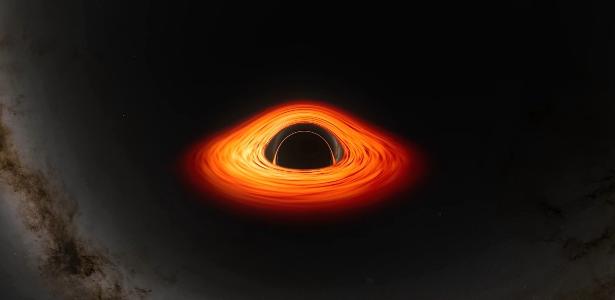
This intense glow, for such a young galaxy, caused suspicions: it can come from the stars, but from a super black hole in complete activity, and the release of energy by warming and the pressure of the surrounding materials.
The information has been confirmed by spectral analysis, which is a technique that analyzes the emitted light or is reflected in a object in different wavelengths, and the detection of information about its chemical composition, temperature, speed and movement.
In the case of black holes, spectrum analysis discovers the gases that revolve and fall towards them. When the gas moves away from the observer, its light becomes more red (Doppler effect), and when approaching, Bluer. This bright “signature” is almost an exclusive evidence of an active black hole.
The result also strengthens the hypothesis that “small red points” were more common in the beginning of the universe than imagined.
A challenge for cosmic theories
The most impressive data is the size: 300 million solar masses, equivalent to half of the stellar block for all its galaxy. Such a great growth in such a short time challenges the current models that have not been expected by very large black holes in cosmic history.

Edward Langley is a contributor at Mediarunsearch.co.uk, covering a wide range of topics including news, politics, business, technology, sport, entertainment and lifestyle. He focuses on delivering clear, balanced reporting and useful information that helps readers stay informed about current affairs and developing stories. His work highlights issues, trends and events that matter to everyday audiences, with an emphasis on accuracy, relevance and accessible journalism.