

The word love is used in a variety of contexts, from romantic feelings to affection for animals and nature. But what happens in the brain when we feel different forms of love? A new study from Aalto University in Finland, published in the journal Cerebral Cortex, has revealed six types of love and provides deeper insight into how the brain interacts with these diverse emotions.
To investigate these questions, the researchers used functional magnetic resonance imaging (fMRI) to analyze the brain activity of 55 people who had children and were in a romantic relationship. The volunteers were asked to think about different scenarios representing six different types of love, including parental love, romantic love, love for friends, strangers, pets, and nature. See the images:
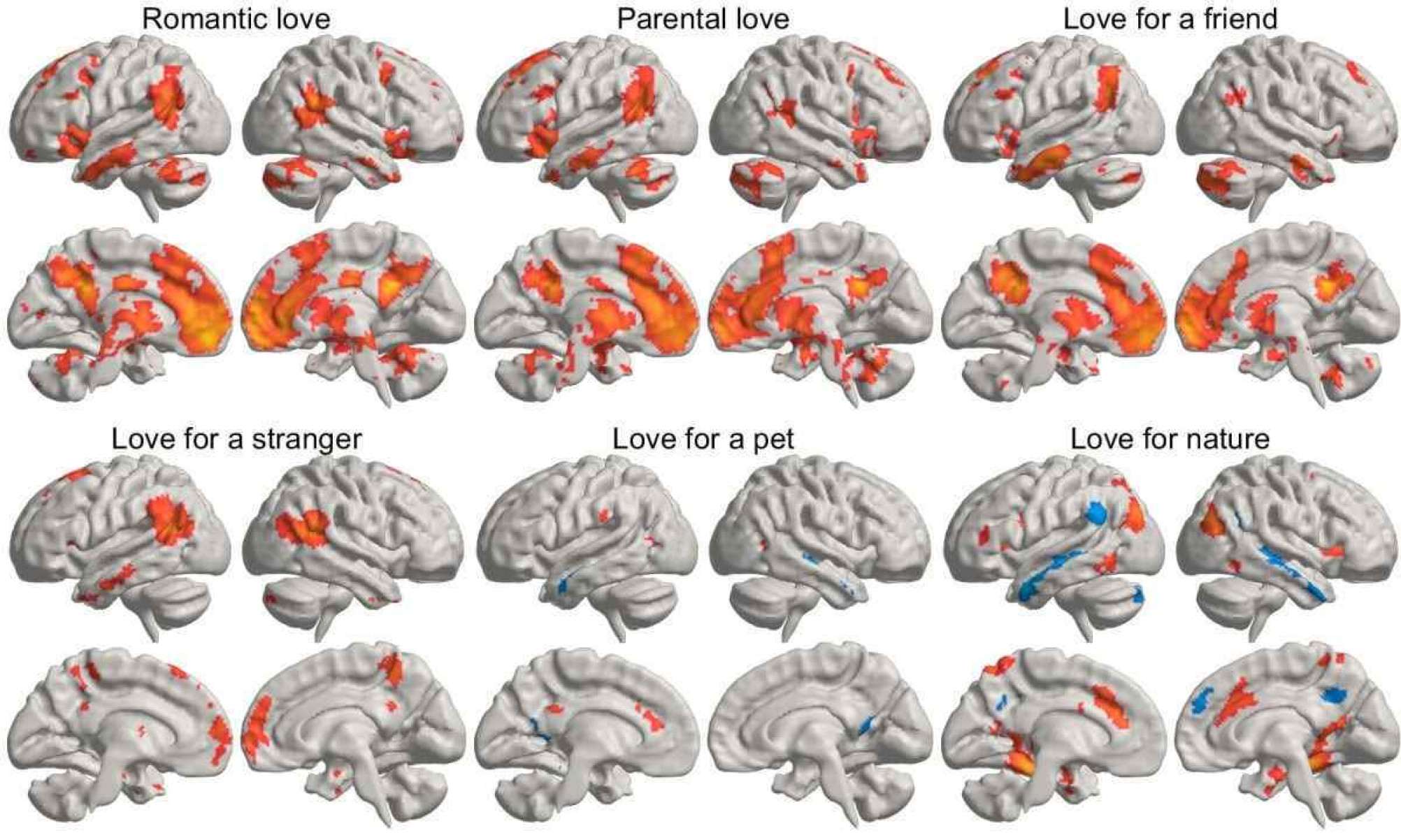
(Image: Aalto University)
According to Bartelli Rehn, a philosopher at Aalto University and lead coordinator of the study, the results reveal a comprehensive view of brain activity associated with different forms of love. “The activation pattern of love is established in specific brain regions, such as the basal ganglia, the midline of the frontal lobe, the precuneus, and the temporoparietal junction.” The study found that feelings for children caused the most intense brain activity, followed closely by romantic love.
In the case of parental love, the researchers observed significant activation in the brain’s reward system, particularly in a region known as the striatum. “This profound activation in the reward system was only observed in parental love and was not replicated in other types of love,” Ren said. On the other hand, the love of romantic partners, friends, strangers, pets, and nature was also analyzed, and the results reinforced significant differences in brain response.
The article highlighted that brain activity is influenced not only by the proximity of the loved one, but also by the species involved. For example, compassionate love for strangers generated less intense brain activity than love in close relationships. On the other hand, love of nature activated the reward system and visual areas of the brain, but not areas associated with social interaction.
An interesting finding was identifying brain regions associated with pet love. Participants’ responses revealed whether they were pet owners based on activation of regions associated with social communication. “When we looked at pet love, the brain regions associated with social communication showed statistically greater activation in pet owners than non-pet owners,” Ren noted.
“Enabling the development of more personalized and effective treatments. For example, treatments that stimulate brain activation associated with positive feelings of love could improve emotional well-being.”
The study controlled for love activation using neutral stories, such as looking out a bus window or absentmindedly brushing your teeth. After listening to interpretations of the love stories by a professional actor, participants were asked to imagine each emotion for 10 seconds.
The findings on differences in brain activation associated with different forms of love have important implications for neurological clinical practice, said Ellen Kiko Fujisao, MD, a neurologist, neurophysiologist and full member of the Brazilian Academy of Neurology and the Brazilian Society of Clinical Neurophysiology. “These findings may help healthcare professionals better understand their patients’ emotional and decision-making processes, especially in relation to relationships.”
Beyond feeling
“Understanding that love is processed in a specific area of the brain could help us better explore how patterns of thinking and behavior influence the way we experience and respond to our feelings. For patients with emotional dependence, for example, this knowledge could be essential for developing more targeted interventions. Furthermore, it is a good reinforcement of the importance of treating love not just as a feeling, but as a neurological process that can be influenced and modified by cognitive therapy, attachment, and toxic relationships.”
Ana Paula Torres, Neuropsychologist specializing in cognitive therapies and relationships
Did you like the article? Choose how to follow the main news from Correio:


Give your opinion! Correio has space in the printed version for readers' opinions to be published by email to [email protected]

Edward Langley is a contributor at Mediarunsearch.co.uk, covering a wide range of topics including news, politics, business, technology, sport, entertainment and lifestyle. He focuses on delivering clear, balanced reporting and useful information that helps readers stay informed about current affairs and developing stories. His work highlights issues, trends and events that matter to everyday audiences, with an emphasis on accuracy, relevance and accessible journalism.