
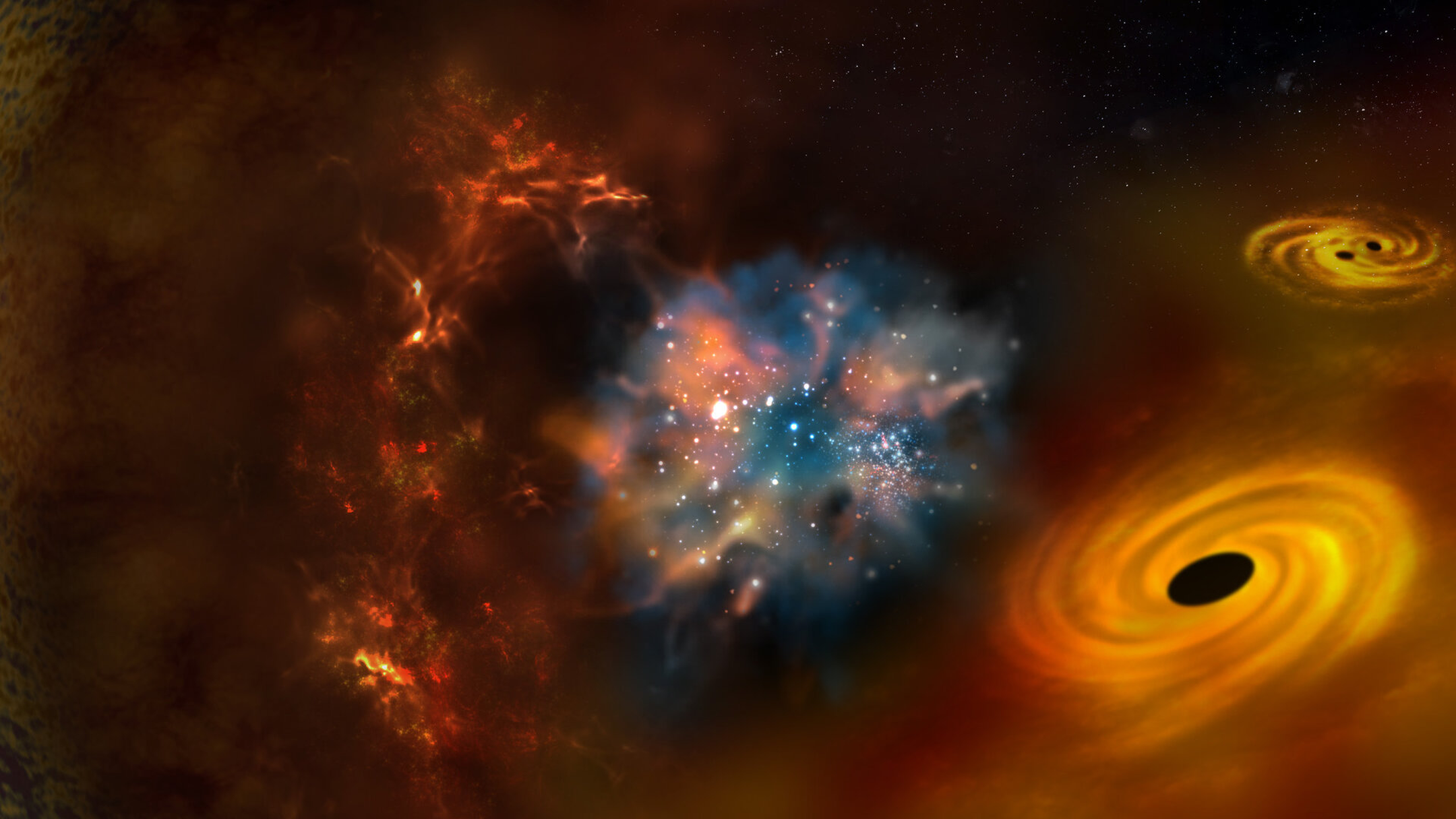
Understanding the accelerating expansion of the universe, driven by mysterious dark energy, is one of the great challenges of modern astronomy. A study published by researchers at Universidade Estadual Paulista (UNESP) can help in this research, as it proposes using concepts from thermodynamics to describe this phenomenon.
The idea of an expanding universe was first proposed in 1927 by Georges Lemaitre, the astronomer and priest who introduced the world to the concept of the Big Bang. Two years later, Edwin Hubble confirmed the idea by observing that distant galaxies were moving away from us.
Since then, astronomers have used a constant to describe the expansion rate, which was initially measured by Hubble itself with a large degree of uncertainty. Today, there are more accurate measurements, but they still differ from each other.
In 1998, astronomers discovered that the expansion was accelerating, leading to the conclusion that the Hubble constant was not exactly constant, but a rate that changed with time. This gave rise to the concept of dark energy, the invisible force that accelerates expansion.
However, no one yet knows exactly what dark energy is, so there is great controversy and different hypotheses put forward to try to explain this mystery. The new study suggests that the change in the expansion rate over time resembles a thermodynamic phase transition.
/i376217.png)
Current measurements indicate that the expansion is adiabatic and anisotropic, that is, without heat exchange and uneven in different regions of the universe. “Basic concepts of thermodynamics allow us to conclude that every adiabatic expansion is accompanied by cooling,” said Professor Mariano de Souza from UNICEF, who led the study.
Even if the expansion system is not exposed to heat exchange with the environment, cooling occurs due to the loss of internal energy used in the expansion work. The converse is also true: if the system contracts steadily, work leads to an increase in energy and therefore temperature.
This relationship between adiabatic expansion and cooling is known as the barocaloric effect, and can be measured by what is known as the Grüneissen ratio. What the UNESP researchers did was apply the powerful Grüneisen parameter to describe aspects of the expansion of the universe.
According to Souza, this “provides a new way to study anisotropic effects associated with the expansion of the universe.” His team expects “a change from a slow expansion regime.” [na era dominada pela radiação e pela matéria] For accelerated expansion system [na era dominada pela energia escura] “It's like a thermodynamic phase transition.”
The article explains that the effective Grüneisen parameter “changes sign when the expansion of the universe changes from deceleration to acceleration. “Such a change in signal resembles a typical signature of phase transitions in condensed matter physics,” Souza added.
If this is true, it means that the cosmological constant (represented by LAMBDA, or Λ) used in the Λ-CMD (Lambda cold dark matter) model has a variable value, unlike the current model which gives Λ a fixed value. This change would lead to a time dependence of this constant, bringing new insights into the universe.
The study was published in Results in physics.
source: Fabisb

Edward Langley is a contributor at Mediarunsearch.co.uk, covering a wide range of topics including news, politics, business, technology, sport, entertainment and lifestyle. He focuses on delivering clear, balanced reporting and useful information that helps readers stay informed about current affairs and developing stories. His work highlights issues, trends and events that matter to everyday audiences, with an emphasis on accuracy, relevance and accessible journalism.