
Advanced materials
Technology Innovation Website Editor – 07/24/2023

The atomic structure of matter corresponds to a crater on a surface of potential energy filled with jagged mountains, hills, and valleys. Computational mapping of this landscape is very difficult, but advanced algorithms and quantum computers can be used to map this terrain.
[Imagem: University of Liverpool]
How to create new materials
We do have metamaterials, whose properties depend on their structure rather than their chemical composition, but the vast majority of everything we use still consists of substances whose properties depend on the chemical elements that make them up.
There are many useful materials in nature, but now we need new things if we want to move towards a sustainable future with less impact on the environment, to make better batteries or more efficient solar panels, for example.
The theory is simple: we just need to design materials that fulfill the functions we need and the functionality we want. But assembling folders is not as simple as assembling Lego bricks.
And the search for new materials is slow and difficult because there are so many ways atoms can combine to make materials, and in particular, they can be built in very different ways. Moreover, materials with metamorphic properties typically have structures different from those known today, and predicting a structure about which nothing is known is an enormous scientific challenge.
This is where the work of Vladimir Gusev and his colleagues at the University of Liverpool in England comes in, who have developed a mathematical algorithm that calculates the structure of any material based solely on knowledge of the atoms that make it up.
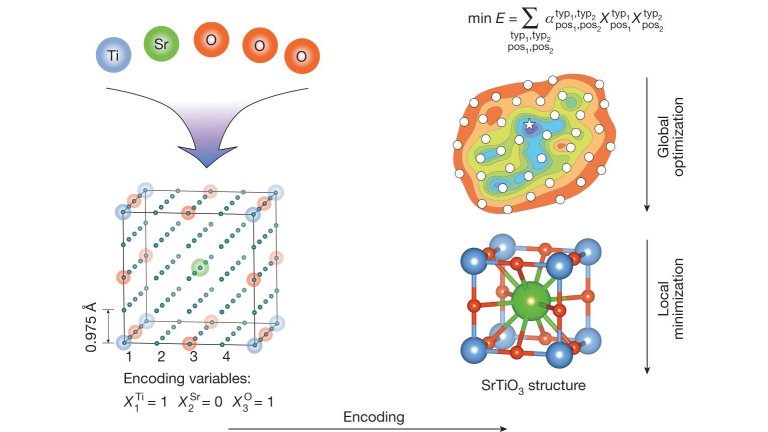
Qubits finds all unknown atomic positions within a unit cell.
[Imagem: Vladimir V. Gusev et al. – 10.1038/s41586-023-06071-y]
Quantum algorithm
Developed by a multidisciplinary team, the algorithm systematically evaluates entire groups of possible structures simultaneously, rather than considering them one by one, to speed up the identification of the correct solution.
This advance makes it possible to identify materials that can be synthesized and, in many cases, to predict their properties.
“Confidence in predicting crystal structures now provides the opportunity to identify materials that can be made and the structures that will adopt them, from across the chemical space, giving us for the first time the ability to define the platform for future technologies,” said Professor Matt Rosinski, team leader.
Rosinski added, “With this new tool, we will be able to identify how to use widely available chemical elements and begin to create materials to replace those based on rare or toxic elements, as well as find materials that are superior to those we have today, to meet future challenges for a sustainable society.”
Quantitative computer test
The new method has been demonstrated on a quantum computer, which has the ability to solve problems faster than conventional computers, and can therefore speed up computational processes even further.
“We provide a general algorithm for crystal structure prediction that can be applied to a variety of structures. Coupling local minimization with correct programming allowed us to explore unknown atomic positions in a continuum space using powerful optimization methods in discrete space,” added Paul Spirakis, a team member.
The team intends to put its algorithm to work, making use of the ‘Materials Innovation Factory’, a lab specializing in new materials set up at the university in partnership with Unilever.
condition: Optimum collateral for crystal structure prediction
Authors: Vladimir F.
Journal: Nature
Volume: 619, pp. 68-72
DOI: 10.1038/s41586-023-06071-y

Other news about:
More topics

Edward Langley is a contributor at Mediarunsearch.co.uk, covering a wide range of topics including news, politics, business, technology, sport, entertainment and lifestyle. He focuses on delivering clear, balanced reporting and useful information that helps readers stay informed about current affairs and developing stories. His work highlights issues, trends and events that matter to everyday audiences, with an emphasis on accuracy, relevance and accessible journalism.