
space
Technological innovation website edited – 07/11/2023
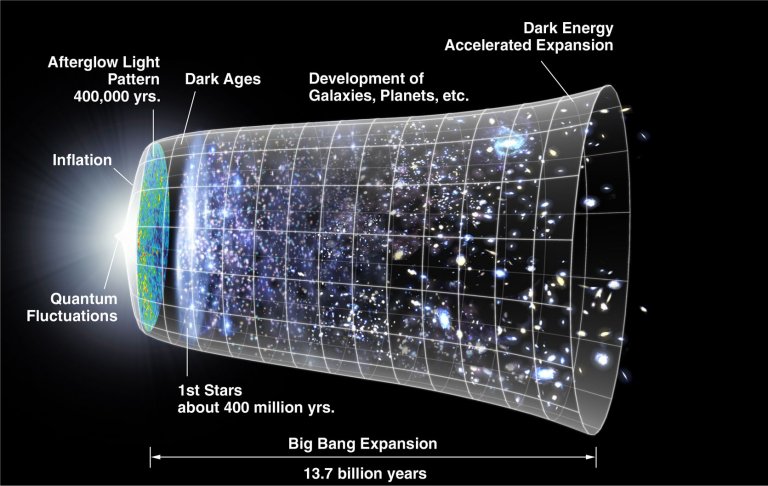
This is the most widely accepted view of the evolution of the universe today. But it may take a lot of tugging.
[Imagem: NASA/WMAP]
The age of the universe
For decades, astronomers and physicists have been calculating the age of our universe by measuring the time elapsed since the Big Bang, mainly by two techniques: by the age of the oldest stars or by galaxies stagnating, based on their redshift. ..
In 2021, thanks to new technologies and technological advances, the age of the universe was estimated to be 13.797 billion years, using the Lambda-CDM concordance model – the cosmological constant, known today as “dark energy”, and the CDM model name is an acronym in English for “cold dark matter”. “.
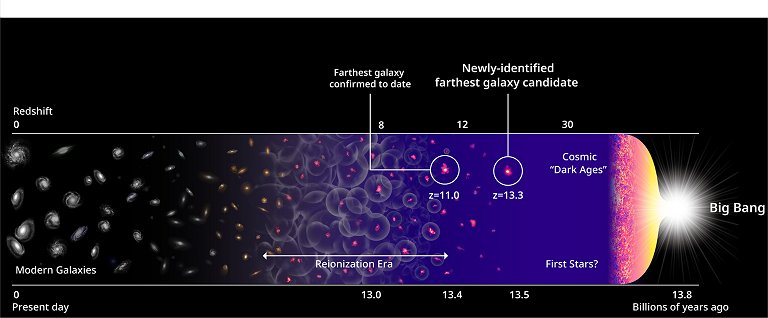
But then came the James Webb Space Telescope, which was supposed to show us the primordial moments of the Universe, a few million years after the Big Bang. The big question was: “What was the universe like in its early days?”
What we saw was completely unexpected: the galaxies Webb saw, existing only 300 million years or so after the Big Bang, seemed to have a level of maturity and mass that should have required billions of years of cosmic evolution. In other words, the ancient universe is very similar to the current one. Moreover, these galaxies are surprisingly small, which adds another layer of mystery to the equation.
These unexpected findings caused a general uproar in the scientific community, but Professor Rajendra Gupta, of the University of Ottawa, Canada, thinks he has the answer: For Gupta, what’s happening is that the universe is much older than science has calculated so far.
“Our newly developed model extends the formation time of galaxies by several billion years, giving the universe an age of 26.7 billion years, not 13.7 as previously estimated,” he said.
[Imagem: Harikane et al. – 10.1093/mnrasl/slac035]
Tired light theory
The basis of Professor Gupta’s reasoning is a theory from 1929, proposed by Bulgarian astronomer Fritz Zwicky (1898-1974), called the “tired light theory”, which proposes that the effect of the redshift of light is not due to the motions of galaxies, but to a phenomenon that would cause them to lose Photons of energy as they travel cosmic distances.
This theory has been set aside because it does not match many aspects of observation, such as the clarity of images of more distant objects, which should be blurry if you really tire the light, the thermal spectrum of the cosmic microwave background, the surface brightness of galaxies and the time expansion of cosmic sources.
But Professor Gupta believes it is possible to revive the theory, which would allow us to escape the currently accepted interpretation of redshift, which proposes that the wavelength of light increases (gets redder) due to the greater speed of distant celestial bodies, which are moving away at increasing speeds due to the expansion of the universe. .
He suggests: “By allowing this theory to co-exist with the expanding universe, it becomes possible to reinterpret the redshift as a hybrid phenomenon, not due to expansion alone.”
association constants
In addition to Zwicky’s tired theory of light, Gupta relied on the idea of developing “coupling constants,” a hypothesis put forward by Paul Dirac (1902-1984). Conjugation constants are fundamental physical constants that govern interactions between particles.
According to Dirac, these constants may have varied over time. By allowing them to evolve, the formation time frame for the first galaxies observed by the Webb telescope at high redshifts could be extended from a few hundred million years to several billion years.
This will provide a more plausible explanation for the advanced level of development and mass seen in these ancient galaxies with the new space telescope.
Furthermore, Gupta suggests that the traditional interpretation of the cosmological constant, which represents the dark energy responsible for the accelerating expansion of the universe, needs revision. Instead, it proposes a constant that explains the evolution of coupling constants. This modification of the cosmological model will help solve the mystery of the small dimensions of galaxies observed in the early universe by Webb.
condition: Early JWST Observations and yCDM Cosmology
Authors: Rajendra Gupta
The Journal: Monthly Notices of the Royal Astronomical Society
DOI: 10.1093/mnras/stad2032

Other news about:
More topics

Edward Langley is a contributor at Mediarunsearch.co.uk, covering a wide range of topics including news, politics, business, technology, sport, entertainment and lifestyle. He focuses on delivering clear, balanced reporting and useful information that helps readers stay informed about current affairs and developing stories. His work highlights issues, trends and events that matter to everyday audiences, with an emphasis on accuracy, relevance and accessible journalism.