

Photo: NASA/JPL-Caltech/clone
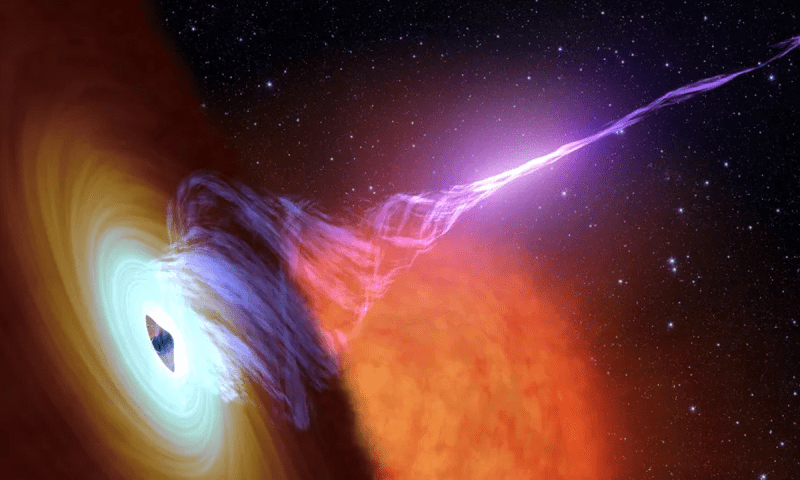
You are black holes Researchers haven’t fully understood it yet, but there are actually a few things science does know about it. One well-known fact is that massive objects emit relativistic jets, defined as beams of ionized matter accelerated near the speed of light.
However, one of these aircraft caught the attention of scientists at Western Sydney University in Australia due to its size. It was no less than a million light-years old and in a galaxy relatively close to the Milky Way, NGC2663.
The word rounding is here applied to an astronomical scale. NGC 2663 is 93 million light-years away from us, which is the equivalent of two masses in the universe. Scientists were able to pick up signals from the jet ejected by the black hole at the center of the galaxy thanks to the Australian ASKAP telescope (Australian Square Kilometer Array Pathfinder).
To give you an idea, the stream of matter forms a mist 50 times larger than the galaxy itself. Using a regular telescope, it is possible to observe NGC2663 in the night sky as a bright elliptical point. On the other hand, if the plane was visible to the naked eye, it would be possible to see a sign in the sky that is larger than the size of the moon.
The full study has been reviewed and accepted for publication in Monthly Notices of the Royal Astronomical Society. It is not yet available in the Scientific Journal, but can now be accessed through the open access repository. arXiv.
In addition to the impressive size, the scientists also observed structures known as “shock diamonds” on the plane. As the jet moves forward, it pushes the gases out of the galaxy. At the same time, gas compresses the plane, causing it to perform an accordion movement. In this process, the so-called diamond is formed.
These structures have previously been shown in smaller streams, but have not been shown on massive scales like those emerging from NGC2663. This indicates the role of the black hole in the evolutionary process of the galaxy: gas feeds NGC2663, which is responsible for fueling the cosmic drainage. This then fires the jet and finally feeds the gas.

Edward Langley is a contributor at Mediarunsearch.co.uk, covering a wide range of topics including news, politics, business, technology, sport, entertainment and lifestyle. He focuses on delivering clear, balanced reporting and useful information that helps readers stay informed about current affairs and developing stories. His work highlights issues, trends and events that matter to everyday audiences, with an emphasis on accuracy, relevance and accessible journalism.