
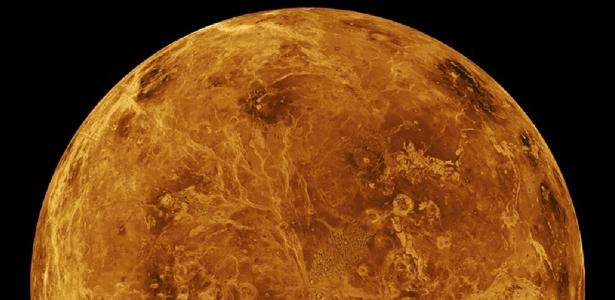
Venus – the second closest planet to the Sun – is shrouded in mystery, and part of these questions have led scientists to christen it Earth’s “evil twin”.
The association of “brotherhood” between the two planets is due to the fact that Earth and Venus emerged from the same material in the solar system – like an egg that splits into two parts, in addition to the similarity of sizes and density.
While Earth has a diameter of 12,742 km, Venus has a diameter of 12,104 km. Information from a site specializing in space science and NASA.
And why “evil”?
Unlike Earth, Venus is an inhospitable planet for humans to live on.
Its atmosphere contains a 24-kilometer-thick atmosphere made of carbon dioxide and clouds of sulfuric acid, which is causing a runaway greenhouse effect.
This scenario results in very hot temperatures. On the surface of Venus, thermometers can reach nearly 480 degrees Celsius, according to NASAhot enough to melt lead.
A study published in 2021 in Nature Magazine also indicated that Venus never had oceans, contrary to perspectives even then.
“It’s a crazy place but a very interesting one,” said Laurie Glaze, NASA’s director of planetary sciences.
The agency itself posted a video on YouTube explaining these reasons. Check it out below (in English).
Three missions to Venus in the next decade
To learn more about the neighboring planet – and find out why and how our planet is so different from it – three space missions are expected over the next 10 years.
“We really want to understand why Venus and Earth are so different,” Glaze said.
They will be led by NASA and the European Space Agency (ESA), as well as cooperation with space companies from other countries.
At this time, a spacecraft will pass by Venus. The goal is to capture data about the planet’s clouds and terrain, to serve as a communications hub for the mission.
In the second phase of the same mission, a special probe will descend through Venus’ thick atmosphere and collect data as it travels through the hazardous environment.
This time, NASA’s plan is to send an orbiter (reusable orbital spacecraft) from the US agency’s space shuttle program.
The last time the agency sent such equipment to visit Venus was in the 1990s.
The purpose of the second mission is to map the history of Venus through its rock activities. Among the points to be studied, volcanoes and whether the planet previously had water will be analyzed.
The Italian Space Agency (ASI), the German Aerospace Center (DLR) and the French Space Agency (CNES) will contribute to this.
The third and final mission scheduled for this decade – more specifically in the early 2030s – is EnVision, from the European Space Agency and with support from NASA.
The researchers intend to study the planet’s hostile atmosphere and inner core.
Scientists want to know, said a text on the Space website, “how two planets in the same part of the solar system and with the same material could form, but produce completely different realities.”
