
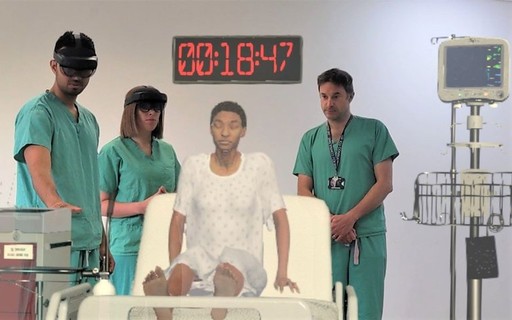

Student Aniket Bharadwaj with trainers Dr. Ruby Woodard (left) and Dr. Jonny Martin (right), identifying a patient with a hologram (Photo: Background/Cambridge University Hospitals)
Students at Addenbrooke’s University Hospital in the UK are the world’s first medical students to use a new mixed reality training system called HoloScenarios, which allows teaching and learning with holographic patients.
The technology was developed by GigXR, a US-based technology company affiliated with Cambridge University Hospitals NHS Foundation Trust (CUH), University of Cambridge. According to the scientists, the system promises to be accessible from anywhere in the world and allows deep and fail-safe learning.
The project gained momentum after the Covid-19 pandemic prevented students from directly interacting with patients to practice and learn medicine. Because of the risk of contamination, interactions were made through pills. With this new method, the experience is different
“Having a patient with a hologram that you can see, hear and interact with is very exciting and can make a difference in student learning. It makes training more interactive and realistic, and you can safely make mistakes and learn from them,” says Aniket Bharadwaj, a medical student and one of the first to try the new technology. In reference.
How does it work?
The system is divided into three modules, the first focusing on common respiratory conditions and emergencies, and the others on cardiology and neurodevelopment.
The first block contains a hologram of someone with asthma, followed by anaphylaxis, pulmonary embolism and pneumonia. For the study, students wear mixed reality headsets that allow them to see each other in real life while interacting with a holographic patient.
Clinical instructors can modify patient responses, introduce problems, and record observations and discussions in person or remotely. Additionally, students can view, contribute and rate patient scenes from an Android or iOS smartphone or tablet.
“Mixed reality is increasingly recognized as an effective method of simulator training. As organizations scale to buy-in, the demand for platforms that offer this utility and ease of learning management is expanding rapidly,” points out Arun Gupta, Cambridge Program Leader and Consultant Anesthetist at CUH. .
In addition to the learning advantage, HoloScenarios provides highly flexible and cost-effective training without the high resource requirements of traditional simulation. These include the costs of maintaining simulation centers, faculty and staff hours to operate their equipment and labs, and hiring and training actors as patients.
The future of medicine
Along with the development and launch of HoloScenarios, the University of Cambridge is conducting research using mixed reality to assess student and patient outcomes.
Professor Sir Stephen Powis, National Medical Director of England’s National Health Service (NHS), says the program will improve the learning experience for the next generation of doctors, nurses and health professionals. “Creating new environments to practice medicine in real time, improving access to practice around the world,” he adds.
GigXR plans to sell the technology to other medical training institutions and schools. If successful, part of the revenue would go back into the NHS, similar to the Brazilian Integrated Health System (SUS).
