
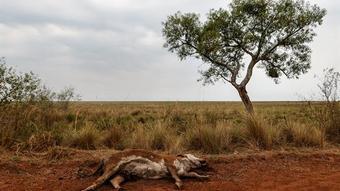
The drought affecting agricultural production in Argentina, the most severe in the past 60 years, is already having repercussions for the country’s economy, with lower exports and lower tax revenues.
The lack of rain has been felt in the fertile and vast Argentinean fields since mid-2022, a year 12.8% drier than average, in a climate that continues this summer, with extreme heat records over the past six decades and strong frosts. .
According to the latest report by the National Drought Control Council of Argentina, there are huge yield losses in agricultural activity, delays and decreases in the final area sown with corn and soybeans, in addition to this phenomenon also having a strong impact on livestock systems.
Inadequate rainfall affects 172.5 million agricultural hectares, of which 8 million hectares are cultivated under moderate to severe drought and 21.7 million head of livestock are at risk, which is a difficult scenario for one of the major food producing and exporting countries in the world that makes up a large part of its economy. on the sector.
Less exports and less revenue
Among the economists, analyzes and projections on the impact of the drought on the already fragile Argentine economy are on the agenda.
“From a macroeconomic point of view, tax collection will be lower. From a regional economies point of view, when the countryside is not working, consumption is falling, you are not investing and not spending,” he said. Leonardo Piazza, to EFE. Director of LP Consulting.
Incidentally, the effects are already evident in the trade balance and financial accounts.
In January, exports fell 11.7% compared to the same period a year earlier due to lower sales of wheat, biodiesel, corn and sunflower oil, showing the impact of the drought already on last year’s crops.
Also in January, the fiscal deficit rose, with a decline in the real value of tax collections on agricultural exports due to the drought.
According to calculations by the Institute for Reality Studies in Argentina and Latin America (IERAL), which is part of the Mediterraneo Foundation, Argentine agricultural exports will total around US$37.8 billion in 2023, down US$8.4 billion from 2022, although the decline could be 6.5%. US dollars. $1 billion if the drought recedes, or $10.1 billion if the weather worsens.
On the financial front, Argentina will raise $7.6 billion this year for agricultural export rights, down $2.05 billion from 2022, but this could be as high as $1.5 billion if climate change conditions improve or $2.4 billion if things get worse.
Bad News
Juan Manuel Garzon, chief economist of IERAL, predicted that “the macroeconomy of 2023 will not find higher returns or greater foreign exchange inflows in the agricultural sector”.
This is bad news for a country that this year needs to meet the targets required to reduce the fiscal deficit and accumulate the cash reserves committed in the agreement signed in 2022 with the International Monetary Fund (IMF).
Experts agree that the drought will affect Argentine economic activity, which is already showing signs of cooling since the last months of 2022.
“Until 2023, we expect the activity to be negatively affected, first, by the drought itself, but also by the decline in foreign exchange resulting from the decline in exports, which will be related to the decrease in the availability of foreign exchange for imports,” he said, LCG said in a report that expects the Argentine GDP to contract by 1 percent. 2% this year.
