
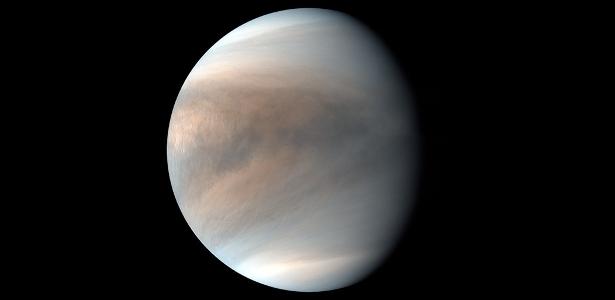
NASA on Wednesday announced two new exploratory missions to Venus, the hottest planet in the solar system, in an effort to better understand why it turned into a hellish place when its neighbor Earth became habitable.
The US space agency reports that these two missions, called DaVinci+ and Veritas, are expected to depart “in the period 2028-2030”. “They will allow the scientific community to study a planet we haven’t visited in more than 30 years,” Bill Nelson, the new NASA administrator, said during the annual address to agency officials.
“There’s Mercury, the planet closest to the sun, which has no atmosphere. Then there’s Venus, with an incredibly dense atmosphere. And there’s Earth, with a habitable atmosphere,” he said. “We hope that these missions will help us better understand how the Earth evolved and why it is currently habitable, when other planets are not.
Davinci+ will have to measure the composition of Venus’s atmosphere and determine if it has an ocean. “The mission consists of a ball that will plunge into the planet’s thick atmosphere, and make precise measurements of the noble gases and other elements,” NASA explained.
Veritas, in turn, will study the geological history of the planet, placing itself in orbit around it. NASA said the mission “will track relief operations over nearly the entire surface of the planet to create a three-dimensional reconstruction of the topography and confirm whether there are processes such as tectonics or volcanism.” Veritas will also need to determine if active volcanoes are releasing water vapor into the atmosphere.
Bill Nelson also confirmed that Artemis 1, the first mission of the US Moon’s Return Program, will launch “later this year.”
