
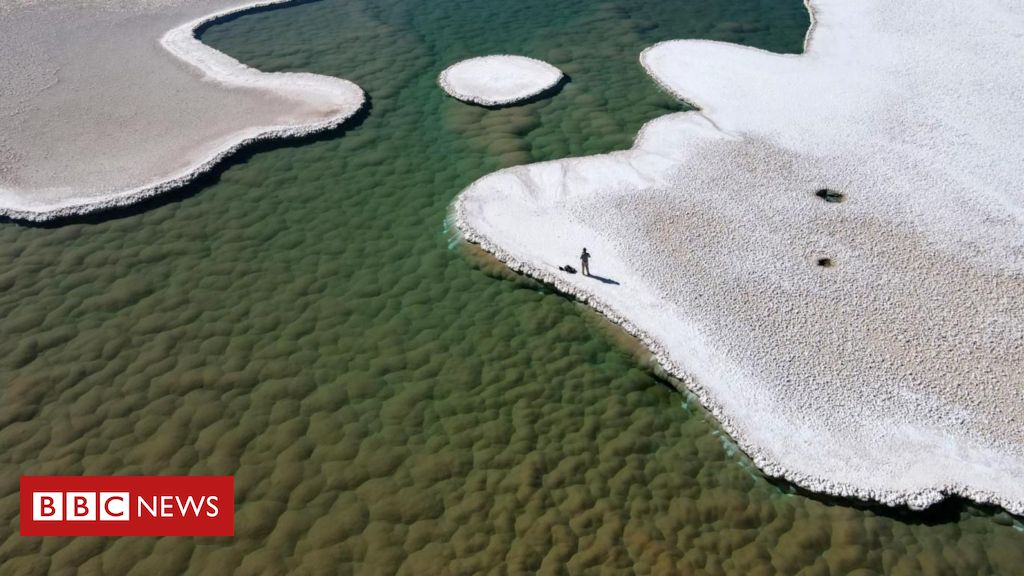
Stromatolites at the bottom of a lake in Puna de Atacama, Argentina
That’s what a team of scientists claim to have found in a “unique in the world” lake ecosystem in Puna Atacama, Argentina.
The discovery, made by geologist Brian Hynek, of the University of Colorado in Boulder, and Argentine microbiologist Maria Farias, was announced last week and came about after studying satellite images of the area.
Hynek and Farias analyzed these images for more than a year, and found what appears to be a specific network of aquifers in the middle of the desert.
They decided to visit this inhospitable plateau about 4,500 meters above sea level, and there they found dozens of lakes with clear, highly saline waters, the bottoms of which were covered with green piles of stromatolite.
Stromatolites, also known as living rocks, are microbial reefs consisting of mineral grains held together by a community of bacteria.
According to NASA, they represent the oldest fossil evidence of life on our planet, dating back to at least 3.5 billion years ago.
Since their origin, they obtained energy from the Sun, and by producing oxygen, they increased the volume of this chemical element in the planet’s atmosphere to about 20%, allowing life to flourish on Earth.
It is estimated that planet Earth formed 4.5 billion years ago.
At that time and for many years, our planet was very different than it is today.
The first fossil records on the planet
When stromatolites appeared, the continents were still forming, so there was a lot of volcanic activity.
Stromatolites are the oldest fossil evidence of life on our planet
The water was laden with arsenic and was saltier than the seas we have today.
There was also no oxygen or ozone layer, explained Maria Eugenia Farias, co-author of this discovery, in an interview with BBC Mundo (BBC Spanish service).
“Under these conditions, the first forms of life appear, namely protobacteria: bacteria that associate and form colonies,” says the Argentine scientist.
During the colony formation process, bacteria capture carbon dioxide.
“Part of this carbon dioxide turns into organic matter and part turns into calcium bicarbonate, which forms a type of living rock that we know as stromatolites,” Farias says.
“These are the first fossil records on the planet.”
An environment similar to that which existed 3.5 billion years ago
Stromatolites released oxygen first into the oceans, then into the atmosphere, and later created the ozone layer.
María Eugenia Farias explains that during the Cambrian Period, and already on a planet with oxygen, eukaryotic life exploded: “Plants and animals appeared that ate the stromatolites and displaced them.”
Conditions on this primitive planet 3.5 billion years ago are those that occur in environments where stromatolites still exist, usually in places with low oxygen levels, high ultraviolet radiation, volcanic activity, and salty water.
Atacama Puna is located near the border separating Argentina, Chile and Bolivia
Stromatolites still live in some salt lakes or bays around the world. These are places where there are not many predators that can eat them.
Australia is characterized by a diversity of stromatolite habitats, both living and fossilized.
Shark Bay, also known as Shark Bay, in Western Australia contains one of its largest habitats.
But, according to Farias, the ecosystem found in the Andes is different due to its location at more than 3,600 meters above sea level.
“The conditions in the Atacama-Puna region, in Argentina, Chile and Bolivia, are special,” he continues. “It is surrounded by volcanoes, has low oxygen pressure and high ultraviolet radiation due to altitude, and has arsenic-laden salt lakes.”
“These conditions are very similar to those that existed on Earth during the first forms of life.”
A piece of Mars on Earth
Hynek and Farias plan to return to Atacama Puna soon to continue investigating gypsum stromatolites specifically.
“Stromatolites are generally composed of calcium carbonate, but stromatolites form under thalassic conditions, that is, with a very high concentration of salt, which are also very similar to those found on Mars,” says Farias.
The scientist highlights the existence of a crater on this planet where there is a large concentration of salt water so that it does not freeze.
“Since we have not yet been able to get to Mars to see if life exists, at least we can see an analogue of this environment here on Earth, in the Atacama Puna.”
