
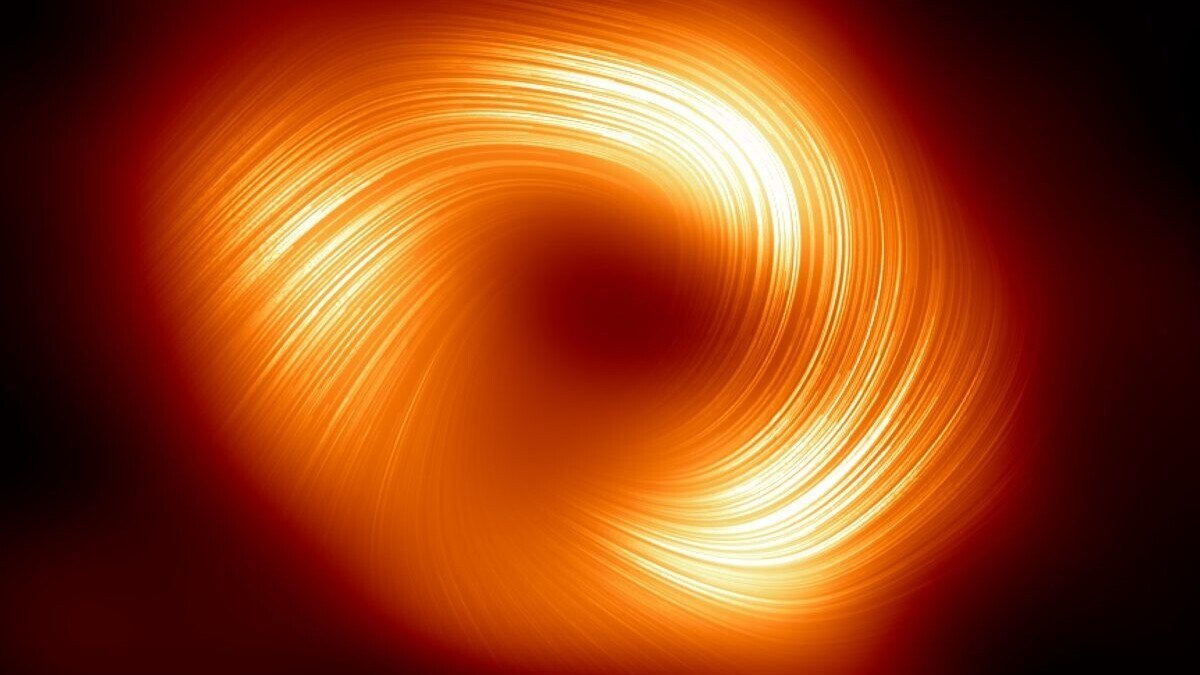
A new image taken by the collaborative Event Horizon Telescope (EHT) project has revealed strong, spirally organized magnetic fields at the edge of the Sagittarius A (Sgr A) black hole at the center of the Milky Way.
The image has similarities to the magnetic field of another black hole much larger than Sagittarius A, called M87, located in the Messier 87 galaxy. This suggests that strong magnetic fields are common to all black holes.
“With a sample of two black holes – with very different galaxies and masses – it is important to determine what they agree on and what they disagree on. Since they point towards a strong magnetic field, this suggests that perhaps this is a universal property or even a fundamental aspect of this type of system.” , explains EHT project scientist Mariafelicia De Laurentiis.
Sgr A is located 27 thousand light-years from planet Earth, and its first image was revealed in 2022, at press conferences around the world. Hence, scientists noticed that Sagittarius A is very similar to M87, which is the first black hole to be recorded and is ten times larger than the other.
Research on M87 indicated that magnetic fields in the region allowed the black hole to expel powerful jets of material into the surrounding environment. Images published in The Astrophysical Journal Letters show that the same may also be true for Sgr A.
Mariafelicia de Laurentiis highlights that while it was easy to capture the release of material in M87, in the case of Sgr A, researchers have not yet been able to record this activity.
Polarized light
To see the magnetic field, the researchers used polarized light. Light is an electromagnetic wave that oscillates and moves. When it is oriented towards a certain side, it is polarized. But humans cannot distinguish this effect from ordinary light with the naked eye. In the case of a black hole, particles along magnetic field lines have a polarization pattern perpendicular to the magnetic field pattern.
By using equipment that captures polarized light, researchers are able to obtain more details about the properties of gas and the mechanisms that occur in black holes.
However, monitoring these systems through these waves is not easy even with the equipment. In the case of Sagittarius A, there was an additional challenge because of the speed at which it moved, and even recording from polarized light became difficult.
The EHT will observe Sagittarius A again in April this year. Expansion plans for the next decade are expected to allow the system's hidden plane to be seen. The international cooperation project includes the participation of 300 researchers from Africa, Asia, Europe, South and North America.
The results were published in two articles in Astrophysical Journal Letters.
The James Webb Space Telescope and its amazing images taken in recent months
Copyright © Estadão. All rights reserved.
