
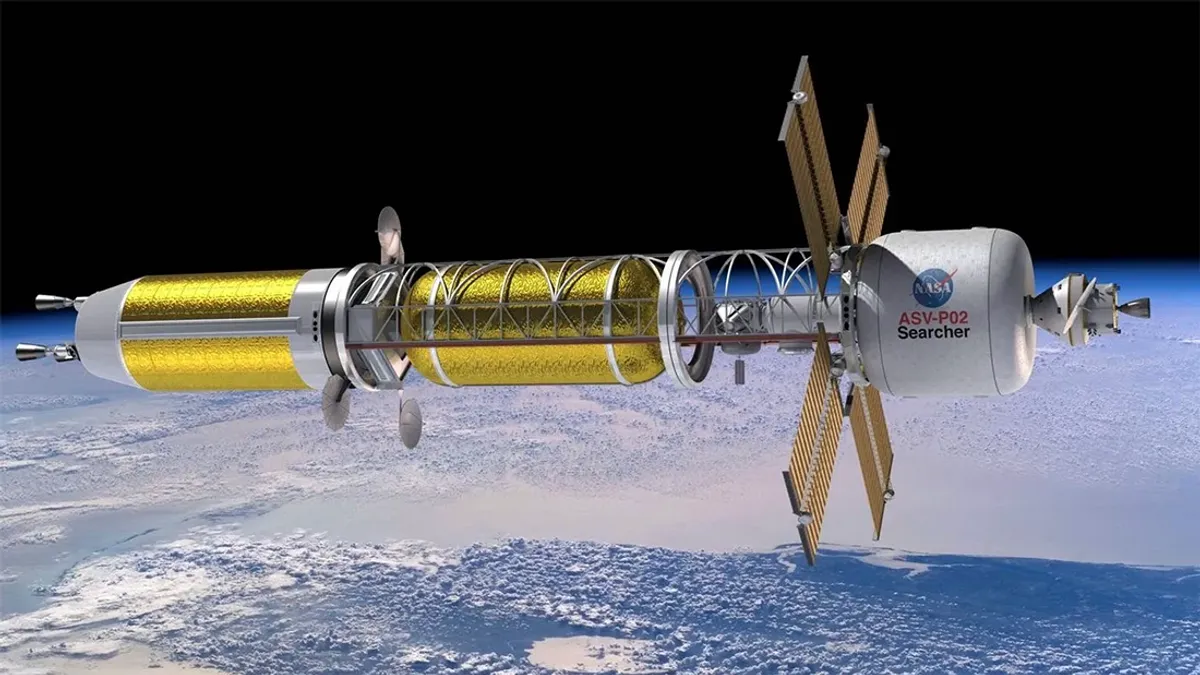
After nearly 60 years, the United States intends to launch a nuclear reactor into space again. Nuclear-powered spacecraft have a number of advantages over those using solar panels, mainly due to their ability to operate in the dark, without sunlight.
The first and only time the United States launched a spacecraft of this type into space was on April 3, 1965, with NASA’s Nuclear Auxiliary Power System 10A (SNAP10A). While in orbit, the ion propulsion system was powered by a nuclear reactor that could provide at least 500 watts for a year or more.
However, SNAP10A only operated for 43 days, because the Agena spacecraft, to which it was attached, ran into problems and was deactivated. Since then, the Soviet Union has launched other reactor launches of this type, but the United States has not.
Now, nearly 60 years later, the U.S. Air Force Research Laboratory wants to launch a new nuclear spacecraft, part of the Joint Nuclear Emerging Technology Supply into Orbit (JETSON) program. The spacecraft is being designed and developed by Lockheed Martin, SpaceNukes, and BWX Technologies, with funding amounting to approximately $33.7 million.
Read more:
Advantages of using nuclear reactors in space
Space missions require a lot of energy, and the sun may not be the best option in some situations. For this reason, researchers hope that nuclear power will be a good solution for missions where the sun is not very close, and even manned missions to Mars and beyond.
The United States used radioisotope thermoelectric generators to send Voyager 1 and 2 into deep space. These probe generators use decaying plutonium to generate electricity, and operate more like a battery than a nuclear-powered ship, like new reactors.
According to Lockheed Martin, In the current situationThe JETSON space nuclear reactor can generate between 6 and 20 kilowatts of electricity, which is four times the power of solar panels. The project is currently in the initial review phase and will soon move to the critical phase.
