
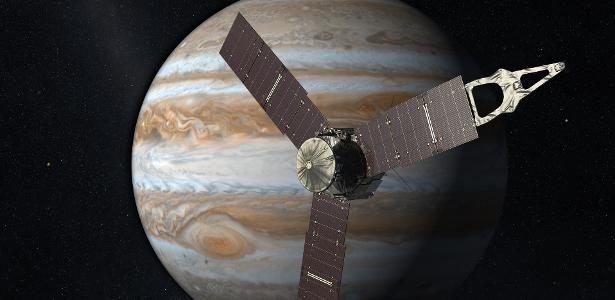
Juno space probe, sent from NASA To analyze the characteristics of Jupiter, he “loses” its memory and connection to the base of operations on Earth after signal interference while flying over a giant planet, in what must be, to say the least, an impressive sight.
The satellite, which completed its 47th observation of the planet on December 16, was inaccessible to scientists at the US Space Agency’s Jet Propulsion Laboratory.
The researchers estimate that the failure could have been caused by radiation from Jupiter’s magnetic layer, or even by the moon Io, which is made up of several active volcanoes.
To bypass the memory flaw, Juno entered “recovery mode” on December 17th. According to an update from NASA on the 27th, the steps were successful, with operators already beginning to download files sent by the probe.
The data transmission should be completed in the next few days, and it will be evaluated by the researchers for malfunctions.
“Scientific data from the latest sunlight-powered spacecraft from flybys of Jupiter and its moon Io appear to be intact,” the space agency said.
It is estimated that Juno will exit recovery mode this week and make another incursion on January 23.
Understand Juno’s mission
Launched in August 2011, the Juno space probe is part of a mission to assess the formations and origins of the largest planet in our solar system by observing it through its very dense clouds.
The spacecraft reached Jupiter’s orbit five years after its launch, on July 4, 2016, on a journey of 2.73 million kilometers.
Juno’s goal was to collect information about the planet in 35 complete orbits around the giant planet, collecting nearly 3 terabytes of data, including unpublished records. Each orbit around Jupiter takes the equivalent of about 53 Earth days.
Scientists expected that the Juno mission would help better understand the formation of planets, as Jupiter is estimated to be the oldest known planet in our solar system.
As a result of the space probe’s incursions, researchers have already discovered that the gas giant has an atmospheric climate layer beyond its water clouds. The planet also has a core consisting of a very heavy metal.
The original Juno mission ended in July 2022. However, science operations for the spacecraft are expected to continue through 2025.
With information from Space.com and the Planetary Society

Edward Langley is a contributor at Mediarunsearch.co.uk, covering a wide range of topics including news, politics, business, technology, sport, entertainment and lifestyle. He focuses on delivering clear, balanced reporting and useful information that helps readers stay informed about current affairs and developing stories. His work highlights issues, trends and events that matter to everyday audiences, with an emphasis on accuracy, relevance and accessible journalism.